An ecommerce sales funnel is the connected journey that turns relevant attention into a retained customer. For a product business, the funnel does not end when somebody places an order. It includes product discovery, evaluation, trust, checkout, payment, fulfilment, delivery, satisfaction, repeat purchase and referral. A business can generate traffic at the top and still lose money when the product page, payment, COD verification, shipping or retention stages are weak.
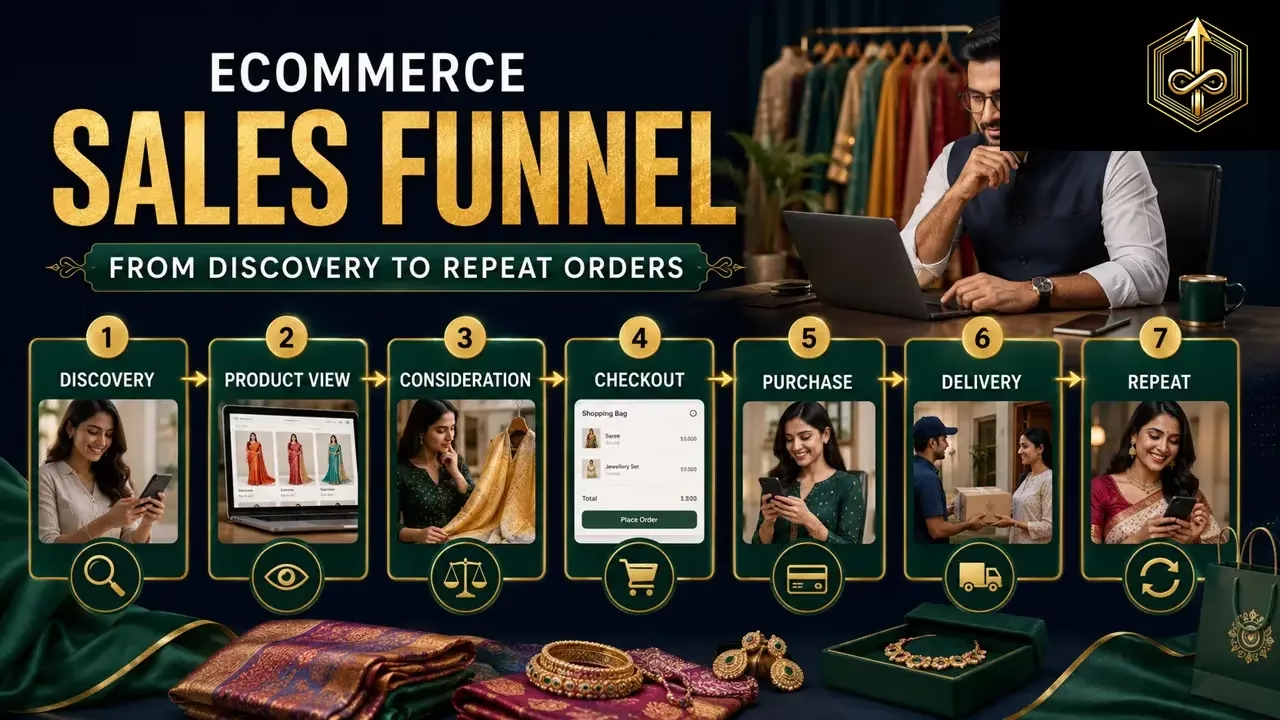
Direct answer: Build your ecommerce funnel in seven stages: Discovery, Qualified Interest, Product Evaluation, Trust & Decision, Checkout & Payment, Delivery & Satisfaction, and Repeat Purchase & Referral. Give each stage a specific customer question, business asset and metric. Diagnose the largest commercially important leak before increasing traffic, and measure confirmed, delivered and retained orders rather than treating every checkout as a successful sale.
Many small product businesses describe their funnel as “run ads, get website visits, receive orders.” That is not detailed enough to manage. A customer may see a reel, search the brand on Google, read a guide, compare two products, ask one question on WhatsApp, attempt a payment, receive the parcel and then decide whether the product matched the promise. The funnel must account for that complete journey.
The funnel creates value only when the right customer moves through the complete order journey.
The right buyer becomes aware of the problem, category or brand.
The buyer recognises personal relevance and explores further.
The buyer judges fit, scale, material, design and value.
The buyer evaluates seller credibility, proof, policy and timing.
The buyer selects variants, enters details and pays or confirms COD.
The business fulfils the promise and the customer retains the order.
A relevant next purchase or recommendation increases customer value.
What Is an Ecommerce Sales Funnel?
An ecommerce sales funnel is a model of the steps customers move through before and after purchasing from an online product business. It helps the business understand where attention becomes interest, where interest becomes product consideration, where consideration becomes an order, and where the order becomes a satisfied and potentially repeat customer.
The word “funnel” is used because a large group may become aware of a brand, while a smaller group evaluates a product and a smaller group completes and retains a purchase. The funnel does not mean that every person should be forced toward checkout. Some people are not suitable buyers, are not ready, or discover that the product is not right for them. Good qualification protects both the customer and the business.
The ecommerce funnel has three jobs
- Create relevant demand: Reach people with a meaningful buying situation.
- Reduce decision uncertainty: Provide product truth, proof and a safe purchase path.
- Deliver customer and business value: Fulfil the promise profitably enough to support retention and growth.
A funnel is a diagnosis tool, not a decoration
Drawing a funnel on a presentation does not improve sales. The model becomes useful only when each stage has:
- A clearly defined customer action
- A business asset responsible for enabling that action
- A measurable outcome
- An owner
- A process for improvement
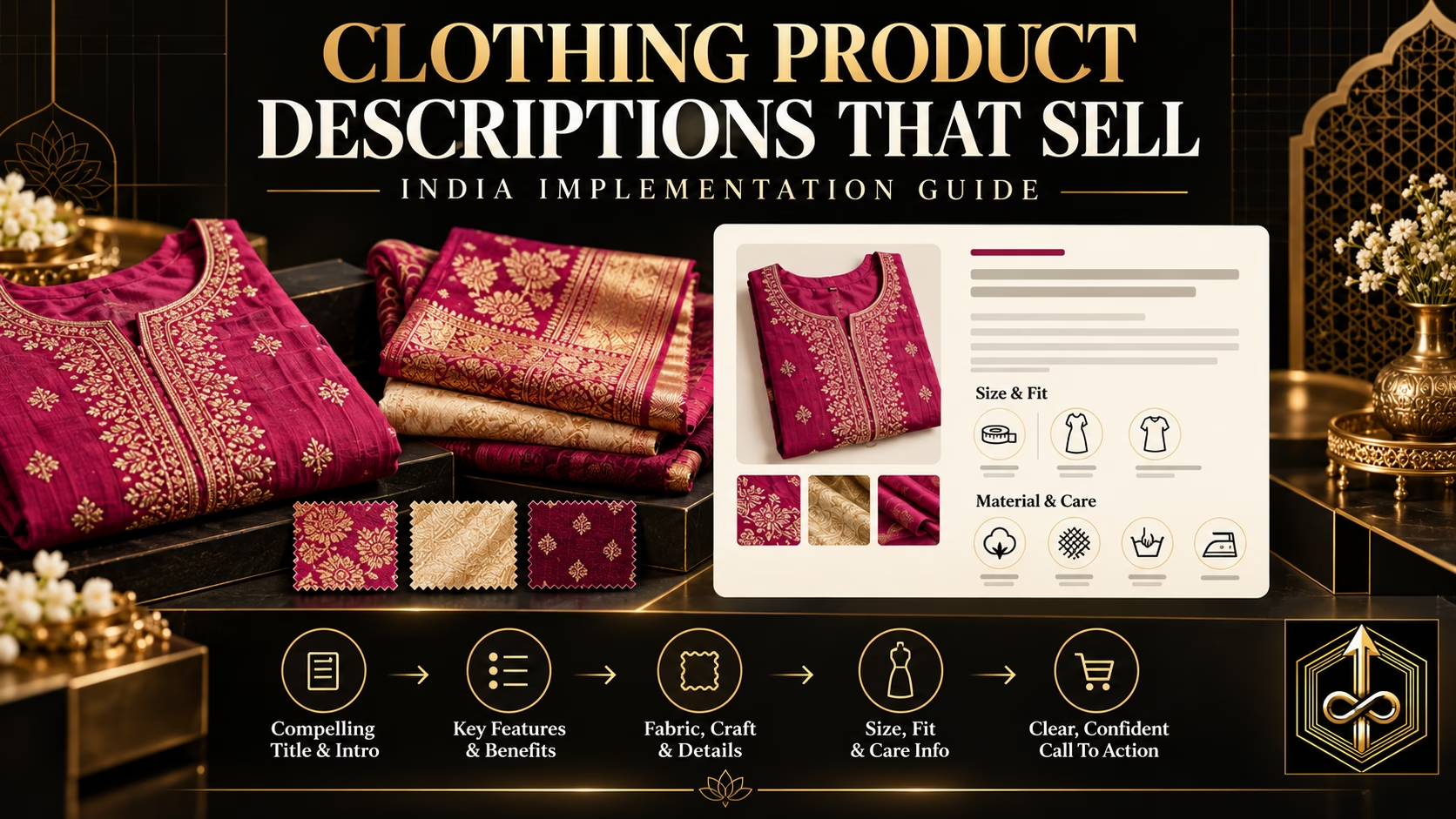
For example, “consideration” is too vague by itself. A clothing business could define product evaluation as a customer viewing a product page, interacting with the gallery, opening the size chart or sending a qualified fit question. A jewellery business may define it through on-model video views, dimensions, material information and a product-page visit.
Why the Ecommerce Funnel Is Not Perfectly Linear
Real customers move backwards, skip stages and use several channels. A customer can discover a product on Instagram, leave, search the brand later, read customer reviews, return directly to the website, add to cart, ask a WhatsApp question and complete payment on another device.
Common non-linear journeys
- Instagram reel → profile → Google search → product page → WhatsApp → website checkout
- Google article → collection page → email signup → later product launch → purchase
- Marketplace product discovery → public brand search → own website → purchase
- Offline shop visit → WhatsApp catalogue → website repeat order
- Creator video → saved post → direct website visit two weeks later → prepaid purchase
The funnel is still useful because it groups the customer’s decision needs. The business should not assume the last click created the entire sale. Discovery content, reviews, offline trust and WhatsApp assistance may all contribute.
Do not confuse attribution with causation
An analytics platform may assign a purchase to one channel according to its attribution rules. That does not necessarily mean only that channel created the purchase. Use platform reporting as one source of evidence, then compare customer conversations, coupon or link usage, content engagement and first-party order data.
Use journeys and funnels together
- Funnel view: Shows the required decision stages and where people drop.
- Journey view: Shows the actual sequence of channels and interactions.
A funnel can reveal that checkout completion is weak. A journey analysis can reveal that many customers reach checkout after WhatsApp assistance and face a payment-app handoff problem. Both views are useful.
The Funnel and the MDP Online Sales Engine
The Meri Digital Pehchan Online Sales Engine connects Buyer Clarity, Product Presentation, Converting Website, Traffic, Sales Conversion and Retention & Scaling. The ecommerce funnel shows how the customer moves through those business systems.
| Online Sales Engine layer | Funnel responsibility | Typical failure |
|---|---|---|
| Buyer Clarity | Reach a customer with a real reason to buy | Cheap attention from unsuitable people |
| Product Presentation | Help the customer evaluate product fit and value | Beautiful but incomplete images |
| Converting Website | Organise information, trust and checkout | Confusing navigation, weak proof or payment friction |
| Traffic | Create qualified discovery from suitable sources | More visitors with no purchase relevance |
| Sales Conversion | Resolve remaining questions and complete payment | Manual follow-up without qualification or structure |
| Retention & Scaling | Deliver satisfaction, repeat purchase and healthy economics | Scaling placed orders while contribution and service decline |
The funnel should be diagnosed from the bottom as well as the top. Before increasing traffic, confirm that the business can convert, fulfil and retain a suitable customer. Otherwise, additional demand magnifies the weakest stage.
Stage 1: Discovery
Discovery is the moment the customer becomes aware of the problem, product category, collection or brand. The objective is not maximum reach. It is relevant reach.
The customer’s question
“Is this relevant to something I want, need or care about?”
Discovery sources
- Google Search and Google Images
- Instagram reels, posts and stories
- YouTube and short-form video
- Creators and affiliates
- Marketplace search
- Existing offline customers
- WhatsApp status or permission-based messages
- Referrals
- Events and local partnerships
- Paid advertising
Discovery content should connect to a buying situation
A generic post saying “New collection available” requires the customer to create the relevance. A stronger discovery angle names a situation:
- Three kurta-set silhouettes for office festive celebrations
- How to choose a saree that photographs well for an evening function
- Statement earrings for high necklines without adding a necklace
- What to check before buying artificial jewellery for a gift
Useful discovery metrics
- Qualified reach
- Search impressions for relevant queries
- Video or content engagement that indicates product interest
- Profile or collection visits
- New visitors from suitable locations
- Cost per qualified visit where paid media is used
Discovery-stage leak
The business can receive high reach but low product exploration because:
- The audience is wrong.
- The content entertains without creating category relevance.
- The product or brand is not clearly identifiable.
- The next step is hidden.
- The creative promises something the destination does not continue.
MDP recommendation
Judge discovery by the quality of people who move deeper into the funnel. A reel with fewer views can be more valuable when it sends suitable buyers to a product page and produces retained orders.
Stage 2: Qualified Interest
Qualified interest occurs when a person recognises that the product or collection may be suitable and chooses to explore further.
The customer’s question
“Does this appear relevant to my taste, situation, price range or requirement?”
Assets that create qualified interest
- Clear profile positioning
- Focused collection page
- Useful category navigation
- Relevant content-to-product links
- Visible price range
- Product previews with actual names
- Occasion, fit, style or use filters
- A concise description of who the collection is for
Difference between interest and curiosity
Curiosity may produce likes, comments or “price?” messages without intent. Qualified interest contains signals such as:
- Viewing a relevant collection
- Opening several product pages in the same category
- Checking size, dimensions, delivery or policy
- Sending a specific product or fit question
- Saving or sharing a product for later consideration
- Returning to the website
Qualified-interest metrics
- Discovery-to-collection click rate
- Collection-to-product-view rate
- Qualified enquiry rate
- Search refinement and filter usage
- Returning visitor rate
- Content-assisted product visits
Qualified-interest leak
People may discover the brand but fail to explore because the profile or homepage is vague, products are not organised by customer logic, prices are hidden or the content has no direct path to the product.
MDP recommendation
Every important discovery asset should have a relevant destination. Send a saree-drape guide to a saree collection, a jewellery-scale reel to the products shown, and a Meta ad to the exact offer rather than a generic homepage.
Stage 3: Product Evaluation
Product evaluation is where the customer determines whether the item itself is suitable. This is one of the most important stages for clothing and jewellery because the customer cannot physically inspect the product.
The customer’s question
“Is this the right product for me, and does the value justify the price?”
Product-evaluation assets
- Complete product-image sequence
- Video showing movement, scale or use
- Accurate title and summary
- Material or fabric
- Garment measurements or product dimensions
- Weight where relevant
- Fit and model context
- What is included
- Care
- Variant and stock accuracy
- Comparison or recommendation
- Genuine reviews with context
Clothing evaluation questions
- Will the size fit?
- How does the fabric fall and move?
- Is it transparent?
- What pieces are included?
- How does the colour look in realistic light?
- Is the length suitable?
- What occasion does it suit?
Jewellery evaluation questions
- What is the actual size?
- How heavy is it?
- How does the back or closure work?
- How does it look on a person?
- What is the material and finish?
- What is included in the set?
- How should it be stored and cared for?
Product-evaluation metrics
- Product-view-to-add-to-cart rate
- Product-view-to-qualified-enquiry rate
- Gallery and video interaction
- Size-chart or dimension interaction
- Product comparison and related-product clicks
- Return reasons connected to expectation gaps
Product-evaluation leak
Traffic may reach the product page but not progress because:
- The first image is weak or misleading.
- Scale, fit or dimensions are missing.
- Product facts are buried in long generic copy.
- The price appears before enough value evidence.
- Variants are confusing.
- The gallery is slow on mobile.
- The customer cannot tell what is included.
MDP recommendation
Treat the product gallery and page as a digital salesperson. Every frame and section should answer a decision question.
Stage 4: Trust and Decision
A suitable product can still fail to convert when the customer doubts the seller, delivery, payment, return process or the truthfulness of the presentation.
The customer’s question
“Can I trust this business enough to place the order now?”
Trust and decision assets
- Consistent business identity
- Clear contact and support information
- Shipping, exchange, return, damage and refund policies
- Realistic dispatch information
- Secure payment experience
- Genuine reviews
- Founder or team visibility where relevant
- Business address or legally appropriate identity information
- Frequently asked questions
- Authentic customer images
- Clear COD and prepaid terms
Trust is not created by badges alone
A row of generic “100% secure” icons cannot compensate for an inconsistent phone number, copied images, unclear returns or unsupported claims. Trust comes from coherence: the product, price, page, policy, communication and delivery should tell the same story.
Decision-stage metrics
- Add-to-cart or enquiry-to-checkout rate
- Policy and delivery-page usage
- Customer-support questions before checkout
- New versus returning customer conversion
- Prepaid versus COD selection
- Time from first product view to order
Trust-stage leak
Customers may add to cart but not begin checkout because the delivery date is uncertain, the return policy is difficult to find, social proof feels artificial, or the business looks different across Instagram, website and payment page.
MDP recommendation
Do not add every possible trust badge. Identify the actual risk the buyer feels and provide corresponding evidence.
Stage 5: Checkout and Payment
This stage converts decision into a confirmed order. It includes variant validation, contact and address details, shipping, payment selection, payment success and order confirmation.
The customer’s question
“Can I complete this purchase easily, safely and without unexpected conditions?”
Checkout essentials
- Mobile-friendly form
- Only necessary fields
- Clear product, variant, quantity and total
- Shipping and COD charges shown before confirmation
- Payment methods that work for the target customer
- Useful validation and error messages
- Cart persistence after recoverable failure
- Duplicate-payment and duplicate-order protection
- Order confirmation
- Support path for payment issues
Prepaid and COD are separate operational funnels
A prepaid order requires payment success, order creation, settlement and refund control. A COD order may require eligibility, verification, dispatch, delivery collection and NDR management. Track them separately.
Checkout metrics
- Cart-to-checkout rate
- Checkout completion rate
- Payment success, failure and pending rate
- COD confirmation rate
- Checkout error by device
- Coupon usage
- Average order value
- Duplicate or missing-order incidents
Checkout leak
A customer may abandon because:
- Unexpected shipping or COD charge appears late.
- The required payment method is unavailable.
- The form is difficult on mobile.
- A coupon field encourages the buyer to leave and search.
- Payment succeeds but confirmation fails.
- The site asks the customer to create an unnecessary account.
- The customer cannot recover from an error.
MDP recommendation
Place real low-value test orders through every important payment and shipping path before sending traffic. Test success, failure, retry, cancellation and refund.
Stage 6: Delivery and Satisfaction
The funnel does not produce a healthy sale until the product is delivered and the customer’s expectation is met. This stage determines returns, reviews, repeat purchase and referral.
The customer’s question
“Did the business deliver what it promised?”
Delivery and satisfaction assets
- Inventory accuracy
- Pre-dispatch quality control
- Protective packaging
- Accurate invoice and order details
- Dispatch and tracking communication
- Delivery-exception management
- Damage-reporting process
- Exchange and return process
- Care guidance
- Responsive support
Delivery metrics
- Confirmed-to-dispatch rate
- Dispatch time
- Delivery rate
- COD RTO rate
- NDR recovery rate
- Damage and complaint rate
- Return and exchange rate
- Reason codes
- Refund-processing time
- Retained-order contribution
Delivery-stage leak
Orders can fail because:
- Inventory was inaccurate.
- Dispatch was delayed beyond the occasion.
- Packaging did not protect the product.
- The product looked or fitted differently from expectation.
- COD communication was poor.
- Support did not resolve a preventable issue.
MDP recommendation
Connect return and RTO reasons back to the earlier funnel stage that caused them. A size return may be a Product Presentation problem. A COD refusal may be a Traffic, Trust or dispatch-timing problem. Do not treat every failed delivery as a courier issue.
Stage 7: Repeat Purchase and Referral
Retention turns a transaction into a customer relationship. The objective is not to send frequent promotions. It is to use the first purchase to understand what may be relevant next.
The customer’s question
“Was the experience good enough to buy from or recommend this brand again?”
Retention assets
- Post-delivery support
- Care and styling guidance
- Honest review request
- Customer preference records with permission
- Relevant new-collection communication
- Complementary product recommendations
- Loyalty or referral system where commercially suitable
- Win-back communication based on actual behaviour
Retention metrics
- Second-purchase rate
- Time to second purchase
- Repeat average order value
- Repeat contribution
- Referral orders
- Review rate and quality
- Customer-support outcome
- Cohort-level retained revenue and contribution
Retention leak
A satisfied customer may not return because the business never asks permission to communicate, sends irrelevant broadcasts, has no coherent next collection, or makes repeat checkout difficult.
MDP recommendation
Build retention from relevance. A customer who purchased festive earrings may not want another pair immediately, but may value a coordinated bangle, care reminder, wedding-season preview or gifting collection later.
Self-Service and Assisted-Selling Funnels
Not every ecommerce purchase should follow the same conversion path.
Self-service funnel
A self-service funnel allows the customer to discover, evaluate and purchase without human assistance. It suits products where the page can answer the decision questions clearly.
Typical path: Content or ad → collection → product page → cart → checkout → delivery → retention.
Assisted-selling funnel
An assisted funnel adds a salesperson, stylist or support conversation when the customer needs recommendation, fit guidance, customisation or reassurance.
Typical path: Instagram or search → product/collection → WhatsApp → qualification → limited recommendation → payment link or checkout → delivery.
When assistance adds value
- High-value or premium purchase
- Fit uncertainty
- Styling or occasion selection
- Gift selection
- Custom or made-to-order requirements
- Complex product comparison
When assistance creates unnecessary friction
- Price is hidden.
- Basic product facts are unavailable.
- Every customer must wait for a reply.
- The salesperson sends too many unrelated options.
- The payment path remains manual and inconsistent.
The strongest product businesses allow self-service where possible and provide assistance where it genuinely improves the decision.
Website, Instagram, WhatsApp and Marketplace Funnels
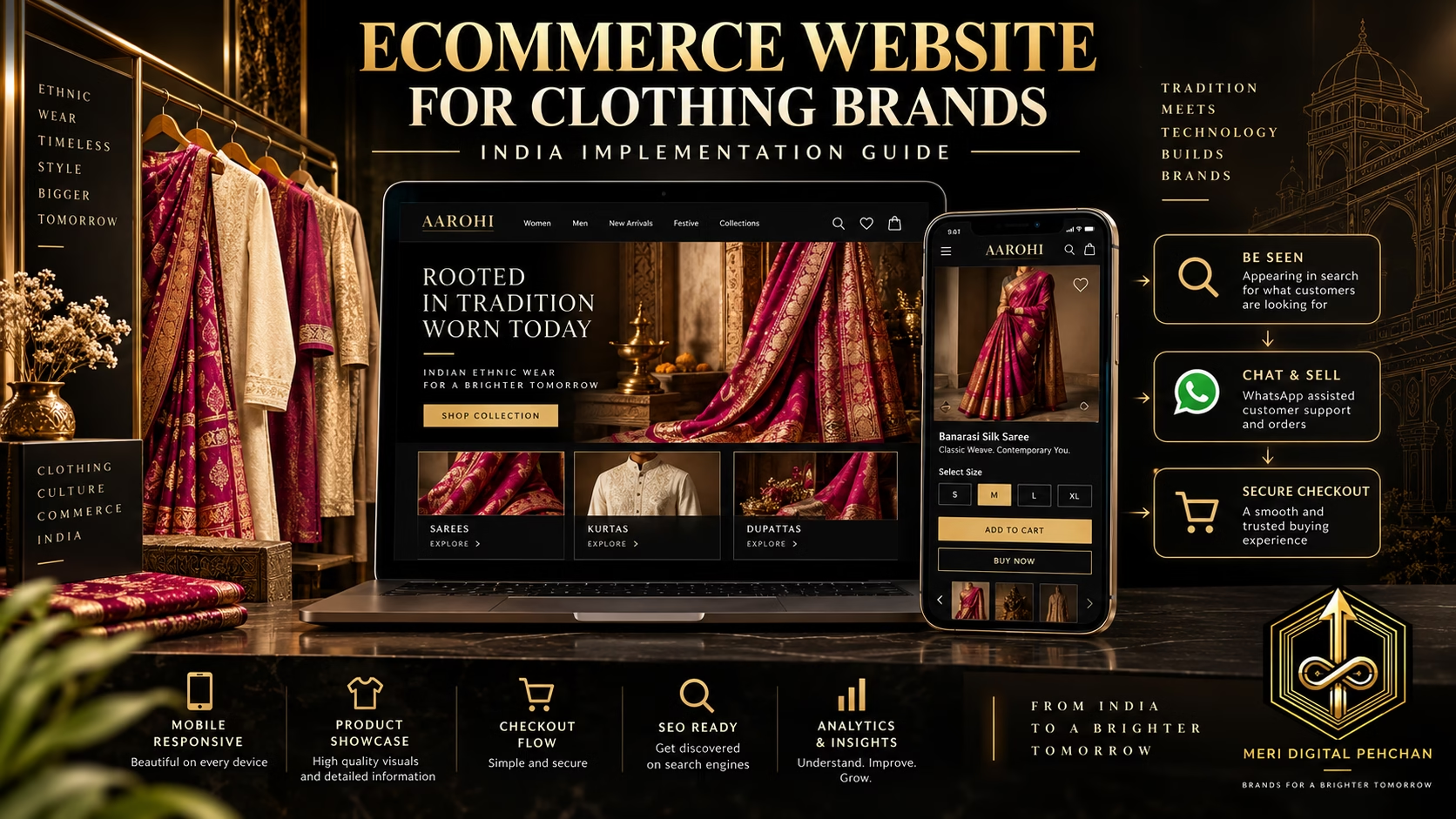
Own-website funnel
Discovery: Search, social, creators, referrals or ads.
Evaluation: Collections, product pages, galleries and reviews.
Conversion: Cart, checkout, payment and confirmation.
Retention: First-party customer relationship with appropriate permission.
The website provides control but does not create traffic automatically.
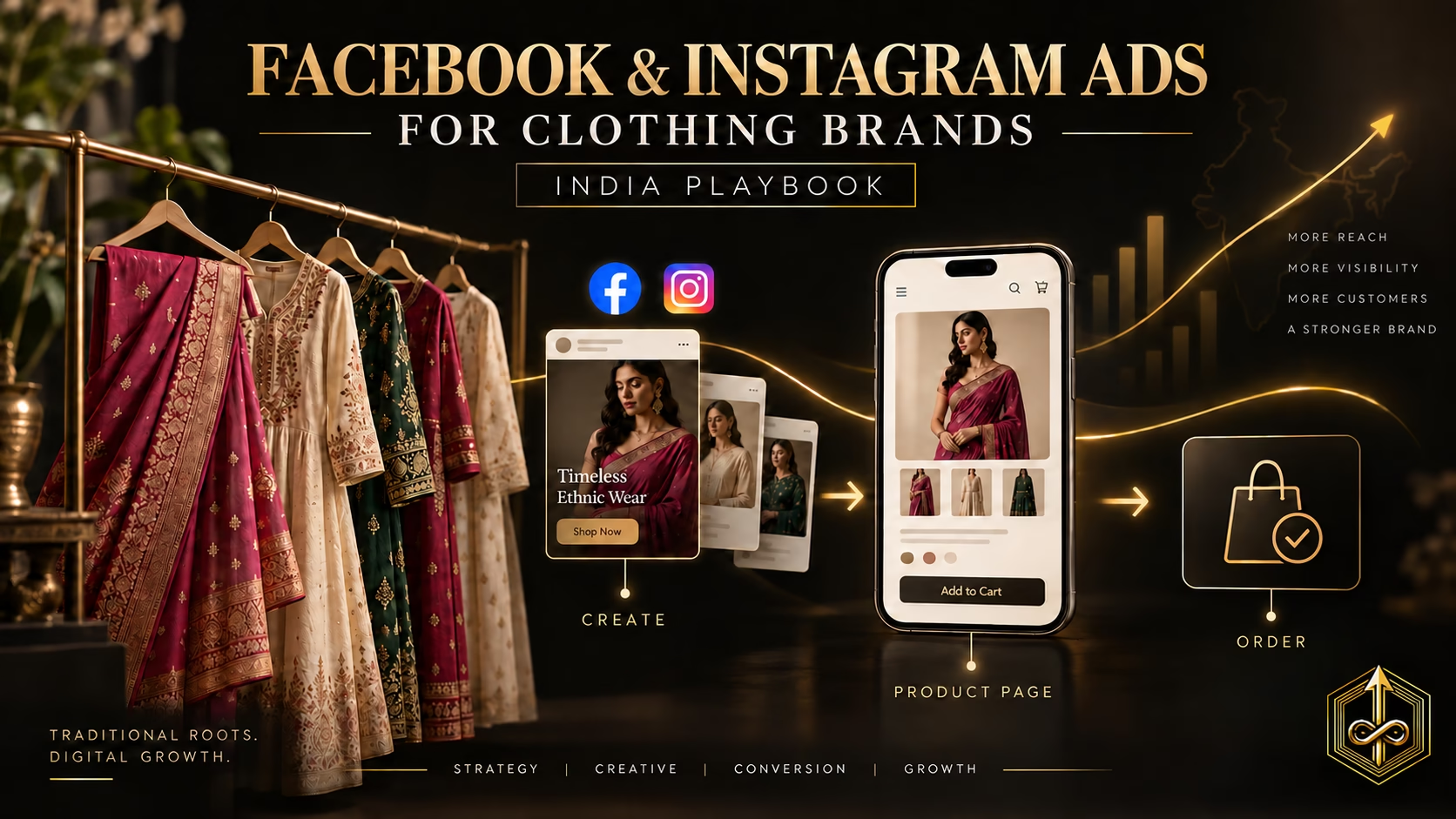
Instagram-led funnel
Discovery: Reels, posts, creator content and recommendations.
Evaluation: Profile, highlights, posts, tagged products and external website.
Conversion: Website or WhatsApp.
Retention: Customer communication should not depend only on future organic reach.
Instagram is powerful for visual discovery, but scattered product information can create manual friction.
WhatsApp-led funnel
Discovery: Existing relationship, social profile, referral or ad.
Evaluation: Structured conversation and limited recommendations.
Conversion: Secure payment link or website checkout.
Retention: Permission-based, relevant communication.
Use the guide to converting WhatsApp enquiries into orders.
Marketplace funnel
Discovery: Marketplace search, category browsing, ads and recommendations.
Evaluation: Listing title, images, attributes, price, reviews and delivery.
Conversion: Marketplace cart and checkout.
Retention: Governed substantially by marketplace rules and customer behaviour.
Use the channel comparison guide to choose the role of each platform.
Ecommerce Funnel Metrics and Formulas
Use consistent definitions. Do not compare a social-media click rate with a delivered-order rate as though they measure the same thing.
Stage conversion formula
Stage conversion rate = People or orders completing the next defined stage ÷ people or orders entering the current stage × 100
Example funnel
The following numbers are hypothetical and demonstrate the method only:
- 2,000 qualified product-page visitors
- 180 add-to-cart actions
- 110 checkout starts
- 80 placed orders
- 68 confirmed orders
- 60 delivered orders
- 56 retained orders
Useful calculations include:
- Product view to cart = 180 ÷ 2,000
- Cart to checkout = 110 ÷ 180
- Checkout to placed order = 80 ÷ 110
- Placed to confirmed = 68 ÷ 80
- Confirmed to delivered = 60 ÷ 68
- Delivered to retained = 56 ÷ 60
- Visitor to retained order = 56 ÷ 2,000
Do not treat the illustrative rates as benchmarks. Use your own category, channel and customer data.
Commercial funnel metrics
- Acquisition cost per placed order
- Acquisition cost per confirmed order
- Acquisition cost per retained first-time customer
- Contribution per order placed
- Contribution per delivered and retained order
- Average order value
- Return and RTO allocation
- Repeat contribution by cohort
Why the deepest metric matters
A campaign can improve product-page conversion but attract customers who refuse COD or return the product. Evaluate the complete customer and economic outcome before declaring the funnel successful.
How to Track the Funnel Correctly
Tracking should reflect actual customer actions and should be tested before decisions are made from it.
Website event tracking
Google Analytics documents recommended ecommerce events including view_item, add_to_cart, begin_checkout, add_shipping_info, add_payment_info and purchase. The purchase event should include a transaction identifier and relevant value, currency and item data. Review the current official Google Analytics recommended events documentation.
Use funnel exploration carefully
Google Analytics Explorations can visualise steps and identify where users leave a task. Sampling, privacy thresholds, consent, implementation errors and cross-device behaviour can affect the data. Use the official Google Analytics Explorations documentation and test event definitions.
Order and fulfilment data
Website analytics cannot replace order truth. Maintain order statuses for:
- Placed
- Paid or COD
- Confirmed
- Dispatched
- Delivered
- RTO
- Returned
- Refunded
- Retained
WhatsApp and assisted sales
Record:
- Enquiry source
- Product or content
- Qualification result
- Question or objection
- Recommendation sent
- Payment link or checkout
- Order outcome
- Support effort
Tracking-quality checks
- Is one purchase counted once?
- Does transaction value match the order?
- Are cancelled and refunded outcomes reconciled?
- Are test orders excluded from business decisions?
- Do browser and server events deduplicate correctly where both are used?
- Does the event fire on the actual action rather than page load alone?
- Are currency and item identifiers consistent?
Do not use precision language for incomplete data
Analytics is evidence, not perfect truth. State assumptions and compare it with payment, order and settlement systems.
How to Diagnose Ecommerce Funnel Leaks
Begin with the largest commercially important leak—not necessarily the largest percentage drop.
Leak 1: High reach, low qualified visits
Likely causes: Wrong audience, entertainment-led creative, unclear product, weak call to action.
Actions: Tighten the buying situation, show the product earlier, use specific content and improve the destination link.
Leak 2: Collection visits, low product views
Likely causes: Poor navigation, weak category introduction, too many products, slow mobile experience, unhelpful filters.
Actions: Organise products by buyer logic, improve collection images and reduce choice confusion.
Leak 3: Product views, low carts or enquiries
Likely causes: Weak presentation, missing fit or scale, value not visible, unsuitable traffic.
Actions: Improve gallery sequence, facts, reviews, comparison and product-buyer fit.
Leak 4: Carts, low checkout starts
Likely causes: Trust, delivery or policy uncertainty; cart surprises; distracting site.
Actions: Make total cost, delivery, returns and support visible before checkout.
Leak 5: Checkout starts, low successful orders
Likely causes: Payment failure, form friction, unavailable method, unexpected charge or technical error.
Actions: Test real devices, review payment logs, simplify fields and create safe recovery.
Leak 6: Placed orders, low confirmations
Likely causes: Low-intent COD, duplicate orders, unreachable details, payment/order mismatch.
Actions: Validate data, create risk tiers, reconcile payments and improve traffic quality.
Leak 7: Confirmed orders, low delivery
Likely causes: Slow dispatch, wrong address, weak tracking, poor NDR action or COD refusal.
Actions: Improve dispatch, address quality, communication and exception ownership.
Leak 8: Delivered orders, high returns
Likely causes: Product mismatch, fit, colour, scale, quality or unsupported expectation.
Actions: Connect reason codes to product presentation, supplier, quality control and traffic.
Leak 9: Satisfied customers, low repeat purchase
Likely causes: No relevant next offer, poor preference records, irrelevant broadcasts or weak assortment.
Actions: Build category, timing and customer-specific retention.
Clothing Funnel Example
Consider a hypothetical boutique launching premium kurta sets for working women attending office celebrations and family functions.
Discovery
Instagram reels and search content show how to choose a polished festive outfit without looking bridal. The message qualifies the buyer by situation.
Qualified interest
The customer reaches an “Office & Family Occasion Kurta Sets” collection with visible price range, size filters and clear styling.
Product evaluation
The product page shows front, back, side, movement, fabric macro, model measurements, garment measurements, lining, included pieces and care.
Trust and decision
The website shows genuine reviews, business identity, dispatch information, exchange terms and support.
Checkout and payment
The customer selects size, sees shipping and payment options, completes prepaid payment or an eligible COD order and receives confirmation.
Delivery and satisfaction
Quality control checks size and inclusions. The product is packed to prevent creasing and dispatched within the promised window.
Repeat purchase
After the first successful order, the customer receives relevant early access to another office-and-occasion collection rather than every product in the store.
Likely clothing funnel metrics
- Collection-to-product views
- Size-chart usage
- Product-to-cart rate
- Size-related support
- Payment and COD confirmation
- Delivery and size-return reasons
- Second purchase by size and collection
Use the complete clothing ecommerce guide to build the category system.
Jewellery Funnel Example
Consider a hypothetical premium artificial jewellery brand selling statement earrings for wedding guests.
Discovery
Creator content and reels show earring styles for different necklines and outfit colours.
Qualified interest
The customer reaches a collection organised by statement level, colour and occasion.
Product evaluation
The product page shows hero, macro, side, back, closure, dimensions, weight, on-model scale, movement, material, care and packaging.
Trust and decision
The brand explains supported product claims, damage reporting, delivery and packaging. Genuine customer images show scale without replacing product facts.
Checkout and payment
Prepaid checkout is simple. COD is controlled for product value, pincode and customer history. The customer sees the final amount and expected dispatch.
Delivery and satisfaction
QC checks stone setting, pair matching and closure. Protective packaging prevents movement.
Repeat purchase
The customer may later receive a relevant coordinated bangle, gift collection or new wedding-season edit.
Likely jewellery funnel metrics
- On-model or measurement interactions
- Product view to cart
- Trust questions
- Prepaid versus COD
- Damage and expectation reasons
- Bundle attachment
- Repeat purchase by occasion
Use the artificial jewellery online-selling guide for deeper category implementation.
Content for Every Funnel Stage
| Funnel stage | Content purpose | Examples |
|---|---|---|
| Discovery | Connect with a buying situation | Mistakes, inspiration, problem diagnosis, styling ideas |
| Qualified interest | Help the buyer choose a category or collection | Buying guides, occasion edits, collection comparisons |
| Product evaluation | Provide product truth | Gallery, dimensions, fit, materials, demonstration |
| Trust and decision | Reduce seller and transaction risk | Reviews, founder process, QC, policies, delivery explanation |
| Checkout | Complete the purchase | Payment clarity, shipping, FAQ and support |
| Delivery | Deliver confidence and correct use | Tracking, care, styling and issue-report guidance |
| Retention | Create a relevant next action | Complementary products, new collection, gifting, referral |
Do not publish content merely to fill every stage. Create an asset when it answers a genuine buyer question and has a clear destination.
Paid Ads and Retargeting Across the Funnel
Cold acquisition
Cold ads should connect a suitable buyer with a relevant product, buying situation or useful problem. The creative, audience, offer and destination should be consistent.
Product consideration
Retargeting can show product proof, customer questions, comparison, founder explanation or a relevant alternative. Avoid repeating the same “buy now” creative to everyone.
Cart and checkout recovery
Recovery should distinguish between:
- Customer still evaluating
- Payment failure
- Delivery or policy uncertainty
- COD eligibility issue
- Technical abandonment
Messages should provide a useful path rather than false urgency.
Post-purchase exclusion and retention
Exclude recent purchasers from irrelevant acquisition ads where practical, and use retention communication based on product category and timing. Do not immediately show a customer the same product at a lower price without a strategic reason.
Measure campaign quality downstream
Compare campaigns by confirmed, delivered and retained contribution. A creative that produces cheap purchases but high RTO is a funnel problem, not a winner.
A 14-Day Funnel Implementation Plan
| Day | Focus | Output |
|---|---|---|
| 1 | Primary buyer and product | One buyer, buying situation and focused offer |
| 2 | Journey mapping | Actual discovery-to-retention path |
| 3 | Stage definitions | Customer action and owner for each stage |
| 4 | Discovery assets | Three qualified-demand angles and destinations |
| 5 | Collection and navigation | Clear route to relevant products |
| 6 | Product presentation | Complete gallery and product facts |
| 7 | Trust | Policies, identity, reviews and support |
| 8 | Checkout test | Mobile prepaid and COD test orders |
| 9 | Fulfilment | QC, packing, dispatch and NDR SOP |
| 10 | Retention | Post-delivery and relevant next-purchase flow |
| 11 | Tracking | Events, order statuses and source fields |
| 12 | Baseline | Current stage metrics and known limitations |
| 13 | Leak prioritisation | One commercially important issue to fix |
| 14 | Controlled test | Documented campaign or warm-audience launch |
MDP Ecommerce Funnel Scorecard
Score each statement from 0 to 2:
- 0: Missing or unknown
- 1: Partly implemented or inconsistent
- 2: Documented, tested and measured
| Statement | Score |
|---|---|
| Discovery reaches a defined buyer and buying situation. | 0 / 1 / 2 |
| Every major content or ad asset has a relevant destination. | 0 / 1 / 2 |
| Collections and navigation reflect customer shopping logic. | 0 / 1 / 2 |
| Product pages answer fit, scale, material, value and inclusion questions. | 0 / 1 / 2 |
| Trust, delivery and policy information is visible before checkout. | 0 / 1 / 2 |
| Prepaid and COD journeys are tested and measured separately. | 0 / 1 / 2 |
| Delivery, RTO, returns and contribution feed back into funnel decisions. | 0 / 1 / 2 |
| Retention is based on relevance and customer permission. | 0 / 1 / 2 |
| Tracking uses consistent events, order statuses and transaction values. | 0 / 1 / 2 |
| The team fixes the most important leak before adding more traffic. | 0 / 1 / 2 |
Interpretation:
- 0–7: The business is generating isolated activity, not a controlled funnel.
- 8–14: The customer path exists but major leaks or measurement gaps remain.
- 15–20: The foundation is strong enough for structured optimisation and channel expansion.
Common Ecommerce Funnel Mistakes
1. Treating the funnel as ads → website → purchase
This ignores product evaluation, trust, delivery and retention.
2. Optimising the top while the bottom is broken
More traffic magnifies checkout, RTO, return and service problems.
3. Measuring all visitors as equally valuable
Qualified traffic matters more than cheap sessions.
4. Sending every campaign to the homepage
The destination should continue the exact product, problem or situation.
5. Hiding product facts to create WhatsApp enquiries
Manual conversation should add value, not replace basic ecommerce information.
6. Using the same content at every stage
Discovery, evaluation and trust require different answers.
7. Counting placed COD orders as sales
Measure confirmation, delivery, RTO and retained contribution.
8. Tracking events without validating them
Duplicate purchases, wrong values and page-load events create false conclusions.
9. Treating returns as a separate department
Return reasons often expose presentation, traffic or product problems earlier in the funnel.
10. Retargeting everyone with discounts
Use the customer’s stage and uncertainty to choose the message.
11. Ignoring support effort
A funnel that converts only through lengthy manual persuasion may not scale.
12. Assuming attribution reports reveal the complete journey
Combine analytics with order data, customer conversations and channel evidence.
Frequently Asked Questions
What is an ecommerce sales funnel?
An ecommerce sales funnel is the connected process that moves a relevant person from discovery to product evaluation, trust, checkout, delivery and repeat purchase. It helps the business identify which stage prevents healthy retained orders.
What are the main stages of an ecommerce funnel?
A practical product-business funnel has seven stages: Discovery, Qualified Interest, Product Evaluation, Trust & Decision, Checkout & Payment, Delivery & Satisfaction, and Repeat Purchase & Referral.
Does the ecommerce funnel end at purchase?
No. An order can still be cancelled, refused, returned or create dissatisfaction. Delivery, retention and contribution are essential parts of the funnel.
How is an ecommerce funnel different from a marketing funnel?
A marketing funnel often focuses on awareness, consideration and conversion. An ecommerce funnel extends into product selection, checkout, payment, fulfilment, returns, repeat purchase and profitability.
How do I calculate ecommerce funnel conversion?
Divide the number of people completing the next defined stage by the number entering the current stage, then multiply by 100. Use consistent definitions and evaluate the deepest retained-order outcome.
What is a good ecommerce conversion rate?
There is no universal rate that applies to every product, price, channel, device and market. Compare your own funnel by qualified source, product, payment and customer type, then improve the most important leak.
Which funnel metric should a small business track first?
Start with qualified product visits, add-to-cart or qualified enquiries, checkout starts, successful/confirmed orders, delivered orders, retained orders and contribution per order placed.
How do I know where my funnel is leaking?
Define each stage, calculate movement between stages, review customer questions and connect returns or RTO to earlier causes. Prioritise the leak with the largest impact on retained contribution.
Do I need advanced software to build a funnel?
No. A small business can begin with website analytics, order statuses and a structured spreadsheet or CRM. The important part is consistent definitions and complete delivery outcomes.
How does WhatsApp fit into an ecommerce funnel?
WhatsApp can provide assisted selection, qualification and objection resolution. It should connect to structured product information and a reliable payment path rather than becoming the only place where basic facts are available.
What is the best funnel for a clothing business?
Use discovery content connected to a buying situation, focused collection pages, product-specific fit and fabric evidence, visible exchange information, mobile checkout, delivery tracking and size-aware retention.
What is the best funnel for a jewellery business?
Use visual discovery, curated collections, macro and on-model product evidence, trust and product-claim clarity, secure checkout, protective fulfilment and occasion-based repeat recommendations.
Should I use discounts at the bottom of the funnel?
Only when economics support the incentive and the customer’s barrier is genuinely price or commitment. Do not use discounts to hide missing product information, trust or payment problems.
How often should I review the funnel?
Review operational metrics weekly and conduct a deeper monthly or campaign-level analysis. Revisit definitions when products, channels, checkout or fulfilment change.
Can a marketplace have a sales funnel?
Yes. Discovery happens through marketplace search and recommendations; evaluation through the listing; conversion through marketplace checkout; and delivery and returns through the marketplace process. Customer relationship and data access are more limited by platform rules.
What should I optimise before increasing ad spend?
Confirm buyer fit, product presentation, trust, checkout, payment, fulfilment, delivery quality and contribution. Increase traffic only when the current funnel produces useful evidence and the business can handle more orders.
Build the Funnel From Retained Customer Value Backwards
A strong ecommerce funnel does not merely push more people toward a buy button. It helps the right customer understand the product, decide with confidence, complete payment, receive what was promised and find a relevant reason to return.
Map the seven stages. Define the customer question and business asset at each stage. Track the deepest outcome. Diagnose the most important leak. Then improve one connected part of the Online Sales Engine before adding more traffic.
Build a complete ecommerce funnel through the Online Sales Engine
Meri Digital Pehchan helps Indian clothing, saree, kurti, boutique and jewellery businesses connect Buyer Clarity, Product Presentation, a Converting Website, qualified Traffic, Sales Conversion and Retention.