
MERI DIGITAL PEHCHAN • INDUSTRY EVIDENCE REVIEW 2026
What Indian Clothing and Jewellery Businesses Must Build to Win Online
A research-led market review, channel strategy and practical readiness benchmark for established clothing, saree, boutique, kurti, artificial jewellery, fashion jewellery and premium jewellery businesses moving from offline dependence to predictable online growth.
Last updated: September 2026. Prepared by: Meri Digital Pehchan. This report is for existing product-business owners who understand their merchandise and customers but need a clearer system for digital presentation, trust, acquisition, conversion and repeat orders.
Executive summary
India’s ecommerce opportunity is no longer restricted to technology companies, venture-funded direct-to-consumer brands or sellers with large teams. Digital payments, logistics access, marketplace adoption and social commerce have lowered many barriers that previously kept established offline businesses local. The India Brand Equity Foundation reports that India’s ecommerce industry was valued at approximately US$125 billion in 2024 and projects it to reach US$345 billion by 2030. IBEF also reports that India had more than 270 million online shoppers in 2024 and that tier-two and tier-three markets are becoming increasingly important sources of online consumption.
Market expansion does not guarantee that every seller will grow. Clothing and jewellery businesses face an unusual online challenge: customers cannot touch the fabric, check the fall of a saree, judge the scale of an earring, test the finish of a necklace or inspect craftsmanship through a screen. The business must replace physical inspection with structured digital evidence. Product photography, styling context, measurement clarity, trust signals, policies, reviews, price justification, responsive communication and dependable fulfilment must work together to reduce perceived risk.
The central conclusion of this report is that online growth will not be won by posting more frequently or running ads in isolation. It will be won by businesses that coordinate six connected capabilities—buyer clarity, product presentation, a converting website, qualified traffic, WhatsApp and sales conversion, and retention and scaling—around one clearly defined customer. Meri Digital Pehchan calls this the Online Sales Engine. It connects an established retailer’s existing product expertise with the systems required for national digital distribution.
Seven findings business owners should understand
- Market growth creates attention, not automatic profitability. More shoppers also attract more sellers and advertising competition.
- Trust is the real online currency. Buyers pay when presentation, proof, policies and communication jointly reduce uncertainty.
- Clothing and jewellery require visual context. A product-only photograph rarely answers questions about fit, scale, occasion, styling or value.
- Websites and marketplaces perform different jobs. Marketplaces offer discovery; an owned system creates positioning, customer data and repeat-purchase control.
- WhatsApp is a conversion layer, not a positioning substitute. Better scripts cannot rescue weak images, unclear prices or low trust.
- Advertising amplifies the system that already exists. Weak pages scale waste; strong systems turn paid traffic into useful learning and sales.
- Readiness should be measured before scaling. Buyer clarity, presentation, conversion and traffic operations need benchmarks before budgets rise.
1. The 2026 market context
India’s retail and ecommerce markets are moving through a structural transition. IBEF projects India’s ecommerce industry to reach approximately US$345 billion by 2030, an estimated compound annual growth rate of 18.4% from its 2024 value. Its retail-sector overview highlights the increasing role of tier-two and tier-three cities in branded consumption and the expansion of D2C brands across apparel, fashion, jewellery, cosmetics and wellness.
These estimates indicate market direction rather than promising individual results. A larger digital market increases the pool of potential customers, but it also raises the standards buyers use to judge sellers. Shoppers who regularly experience refined product pages, fast payments, clear policies and dependable delivery begin to expect comparable clarity from smaller businesses. The practical opportunity for an established retailer is therefore not merely to “go online.” It is to translate offline strengths into a digital buying experience that can compete for trust.
The gems and jewellery sector illustrates the scale of the opportunity. IBEF reported that India’s gems and jewellery market stood at approximately US$85 billion in January 2026 and projected expansion to US$130 billion by 2030. The sector contains different business models—from precious jewellery retailers to premium imitation jewellery, occasion-led collections and everyday accessories—but nearly all depend on trust, visual accuracy and confidence in the seller.
Fashion and apparel benefit from frequent purchase occasions and wide product variety, yet experience high comparison, fit uncertainty, return risk and discount pressure. Traditional retailers frequently possess deep product knowledge, local goodwill and supplier relationships. Their weakness is rarely the product alone. It is the failure to package product knowledge into photographs, descriptions, size guidance, merchandising, social proof and follow-up systems that a distant customer can understand without entering the shop.
2. Why offline reputation does not automatically transfer online
Offline trust is experiential. A customer sees the store, speaks to the owner, touches merchandise, compares options and observes other customers. Online trust is evidential. The buyer sees only what the business deliberately provides. When critical evidence is absent, the buyer generally postpones the decision, asks only for the price or leaves.
A respected local retailer can therefore struggle online despite excellent stock. A ₹3,000 kurti may appear like a ₹700 item when lighting flattens the fabric, styling is generic, detail work is hidden and fit information is absent. A heritage-inspired necklace can appear oversized or artificial when images fail to preserve realistic scale, metal texture, stone detail or on-model context.
The digital brand must turn invisible strengths into visible signals. Years of experience become an expert buying guide. Loyal customers become verified reviews and detailed stories. Product knowledge becomes accurate descriptions and styling recommendations. Good service becomes a transparent support and exchange process. Strong supplier relationships become dependable stock and fulfilment. The goal is not to imitate a giant marketplace; it is to make the brand’s specific competence easy to see and believe.
3. The MDP Online Sales Engine
Step 1: Buyer clarity
Buyer clarity defines who the business serves, which purchase occasions matter, what the customer is trying to achieve, what makes her hesitate and why she should choose this brand. “Women interested in fashion” is too broad. A more useful definition may describe a boutique customer who wants polished ethnic wear for work and family occasions, values styling guidance, prefers dependable sizing and pays more when quality is made visible.
In jewellery, the same customer may buy for a wedding, festival, gift, office wardrobe or a particular outfit. Each context changes acceptable design, price, scale, delivery urgency and proof. Buyer clarity therefore governs product selection, photography, content, advertising, website structure and follow-up language. Without it, the brand presents everything to everyone and becomes memorable to no one.
Step 2: Premium product presentation
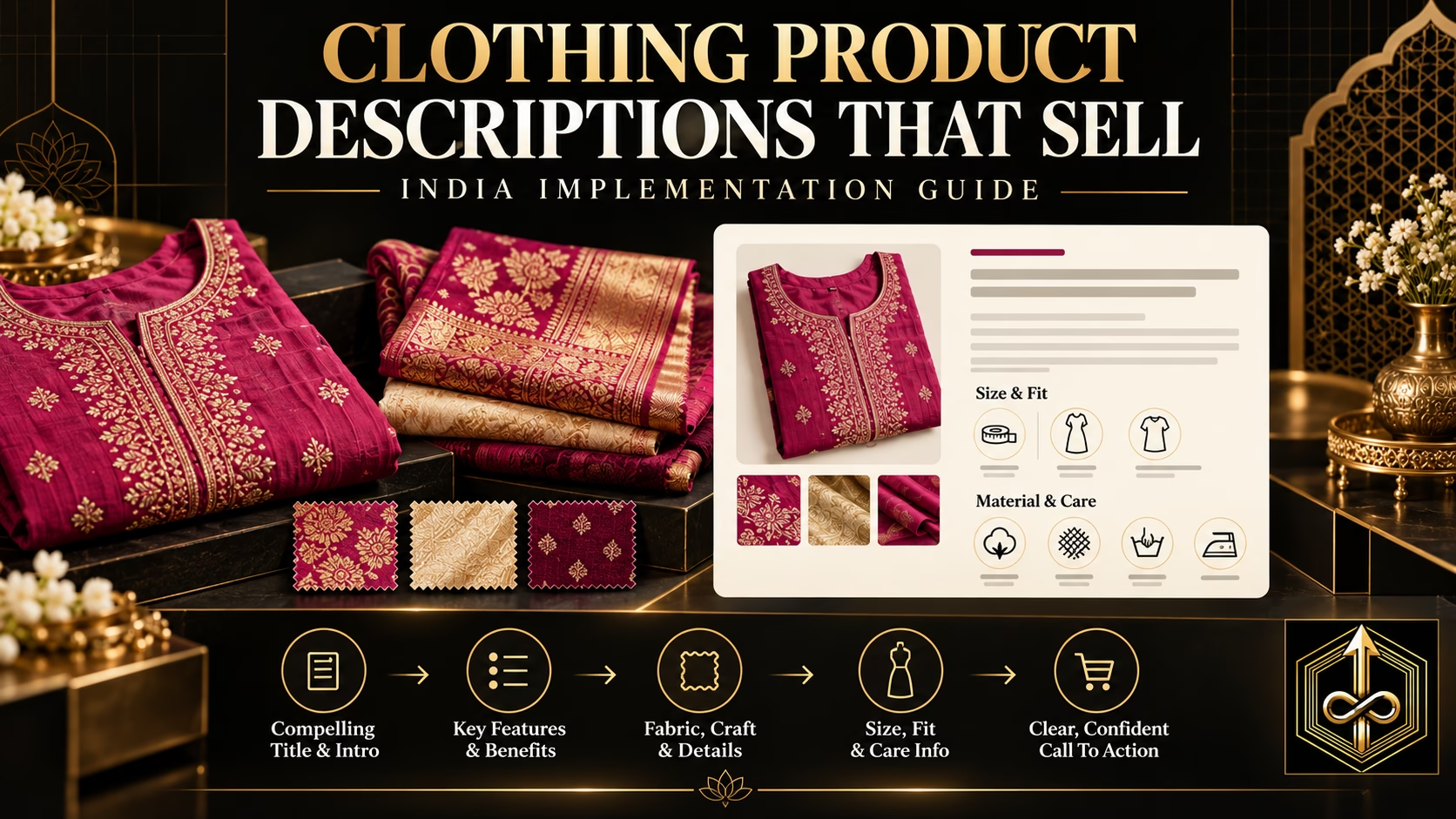
Presentation is the digital replacement for touch, trial and physical inspection. A useful ecommerce gallery should show a clean hero image, accurate colour and construction, close details, alternate angles, realistic scale, an on-model view, styling context and packaging where relevant. Clothing additionally needs fit, length, fabric behaviour and size information. Jewellery needs scale, closure, dimensions, craftsmanship detail and occasion-led styling.
Accuracy matters as much as beauty. Over-edited photographs can increase clicks while reducing trust and increasing returns. Images should preserve the actual design, stone placement, embroidery, colour family and proportions. Premium presentation raises perceived value only when faithful to the product delivered.
Step 3: Converting website
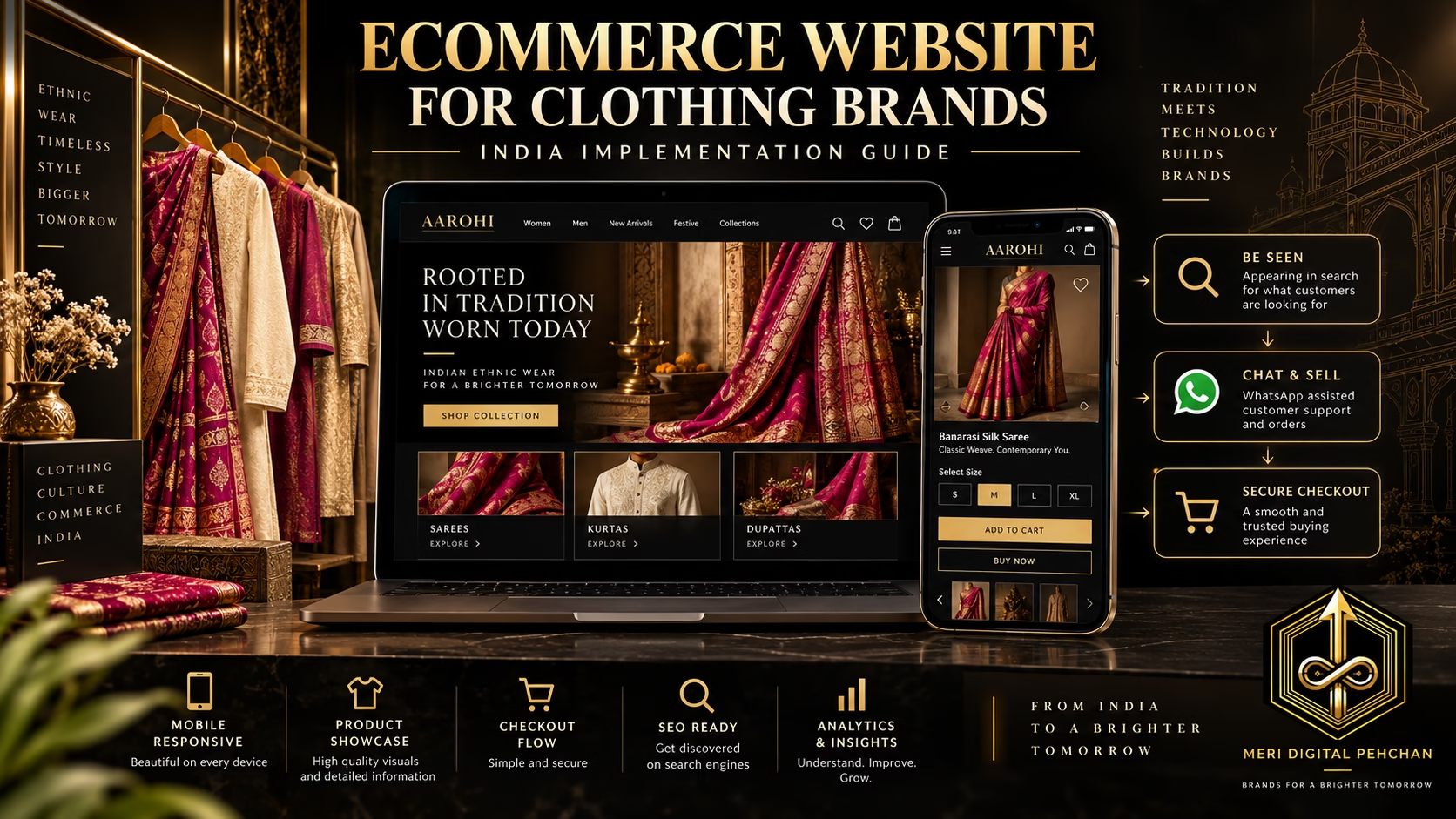
A converting brand system coordinates positioning, navigation, product pages, policies, proof and calls to action. The homepage must state who the business serves and what outcome it enables. Category pages should help customers narrow choices. Product pages should answer the questions that usually appear in WhatsApp conversations. Reviews must be specific enough to be credible. Shipping, returns, exchanges and support should be visible before payment.
Step 4: Qualified traffic
Traffic includes organic search, social content, creator partnerships, marketplaces, referrals and paid advertising. Each audience should reach the page that most directly answers its intent. Traffic quality matters more than cheap clicks: the business should measure whether visitors understand the positioning, inspect products, begin checkout, ask relevant questions and become delivered customers.
Step 5: WhatsApp and sales conversion
WhatsApp supports assisted conversion when the buyer needs fit, styling, scale, delivery or payment guidance. A reliable process records consent, responds with product-specific evidence, asks only useful questions, handles objections honestly, makes payment simple and confirms the order. Repeated questions should improve the website instead of remaining trapped in private chats.
Step 6: Retention and scaling
Retention includes post-purchase communication, review requests, relevant replenishment or occasion-led offers, customer segmentation and repeat-purchase campaigns. Scaling means increasing volume only while contribution margin, return rates, fulfilment quality and customer satisfaction remain healthy.
The sequence matters. Traffic should rise after the business has a defined buyer, trustworthy presentation and dependable purchase path. Otherwise the owner pays to discover weaknesses that could have been corrected before media spend. A prepared system does not eliminate testing; it ensures each test answers a meaningful question.
4. The 20-point Online Brand Readiness Score
Use this benchmark before increasing advertising budgets. Score each dimension from one to five. The maximum is twenty. It is a diagnostic framework, not a revenue guarantee, and should be updated as evidence improves.
| Dimension | 1 point | 3 points | 5 points |
|---|---|---|---|
| Buyer clarity | Broad audience; no occasion or objection map | Basic segment and use cases documented | Specific high-value buyer, occasions, objections and decision criteria guide every channel |
| Product presentation | Single or inconsistent images; limited detail | Clean images, description and basic context | Accurate conversion gallery, scale, fit, details, styling, video and objection-clearing information |
| Brand and conversion | Social catalogue without a dependable path to purchase | Functional website and policies with some proof | Clear positioning, structured website, strong pages, proof, policies and friction-controlled checkout |
| Traffic and follow-up | Random posting or boosting without measurement | One or two repeatable channels with basic follow-up | Diversified acquisition, structured follow-up, event tracking and decisions based on unit economics |
- 4–8 points: Foundation stage. Fix the customer definition, presentation and purchase-path basics before aggressive promotion.
- 9–12 points: Validation stage. Run controlled tests, document objections and improve the weakest dimension before adding budget.
- 13–16 points: Growth stage. Expand winning traffic sources while improving conversion and follow-up.
- 17–20 points: Scaling stage. Increase volume carefully while protecting contribution, fulfilment and customer experience.
5. Clothing business benchmarks
A clothing brand’s online system must answer what the garment looks like, how it fits, how it feels, where it can be worn and why it is worth the price. Many pages answer only the first question. The customer is then forced to guess about body type, garment length, transparency, fabric weight, care, styling and occasion. Every unanswered question adds friction.
For sarees, a complete gallery should accurately show colour, border, pallu, weave or print, blouse piece, drape and close craftsmanship. Descriptions should distinguish handloom, power-loom, handcrafted and machine-made details accurately instead of using premium language loosely. For kurtis and kurta sets, show full length, front and back, side silhouette, neckline, sleeves, fabric texture, bottom and dupatta where included. Size charts should reflect the actual garment and state garment measurements clearly.
Occasion-led merchandising is valuable because customers do not always search by product type. They search for an office look, wedding-guest outfit, festive set, travel-friendly kurta, summer cotton or gift. Organising products and articles around these jobs improves discovery and helps the buyer imagine ownership. It also gives search engines and referring publications more precise topics to associate with the brand.
Clothing businesses should analyse size-wise returns, colour complaints, fit questions, exchange reasons and repeat purchase by category. These are product-content metrics as much as service metrics. A pattern of returns around one size or fabric description should trigger a page correction before more traffic is sent.
6. Jewellery business benchmarks
Jewellery customers evaluate design, scale, finish, comfort, security, styling and seller trust. The more premium the positioning, the more disciplined the presentation must become. A product shown too large on the model creates disappointment. A highly reflective edit can make metal appear unlike the delivered piece. A gallery that shows only the front hides the closure, reverse construction or wearing mechanism the customer needs to understand.
For earrings, show a clean product view, macro detail, closure, side profile and realistic on-ear scale. For necklaces and chokers, show the entire product, central motif, stone or enamel detail, tying mechanism, on-neck fall and outfit context. For bangles and kadas, show the exact number of pieces included, interior and exterior construction, opening mechanism where applicable and realistic wrist scale. Each image must preserve design truth.
Descriptions should avoid unsupported claims. Material, plating, stone type, care instructions and dimensions should be clear. Premium artificial jewellery should be positioned through design, craftsmanship, finish, styling versatility, curation and service rather than language that could be mistaken for precious material. Clear category truth builds confidence and protects long-term reputation.
Higher-value jewellery needs visible trust architecture: secure payments, authentic business information, packaging, dispatch practices, exchange terms, customer support and detailed reviews. The founder or curator can strengthen authority by explaining design selection, construction and styling decisions rather than relying only on promotional adjectives.
7. Choosing the right channel mix
No single channel should perform every job. Social platforms are effective for discovery, demonstration and community. Marketplaces provide established demand and transaction infrastructure but can limit differentiation and customer ownership. An owned website provides control over positioning, merchandising, data and retention, but the business must generate trust and traffic. WhatsApp supports consultation and follow-up but becomes difficult to scale when every answer depends on the owner.
| Channel | Primary role | Main strength | Main risk |
|---|---|---|---|
| Instagram and short-form video | Discovery and desire | Visual storytelling and rapid feedback | Engagement without purchase; dependence on platform reach |
| Marketplaces | Demand capture | Customer familiarity and transaction trust | Price comparison, fees and limited ownership |
| Owned ecommerce website | Brand, conversion and customer ownership | Control over positioning, experience and data | Requires deliberate trust and traffic |
| Consultation and assisted conversion | Personal guidance and objection resolution | Manual workload and inconsistent follow-up | |
| Email and customer community | Retention and repeat purchase | Direct access to existing customers | Weak results when relevance and consent are ignored |
A practical starting model uses social content for discovery, an owned website for structured education and purchase, and WhatsApp for high-intent assistance. Marketplaces can be added where demand and economics suit the category. The correct mix depends on margin, catalogue depth, average order value, purchase frequency, fulfilment capacity and the team’s ability to maintain each channel.
8. Metrics that matter before scaling
Revenue alone cannot reveal whether a digital sales system is healthy. Conversion rate shows the share of qualified visitors who order. Average order value shows transaction size. Customer acquisition cost measures what is spent to acquire a new buyer. Contribution per order estimates what remains after product cost, packaging, shipping, payment fees, discounts, expected returns and variable advertising. Repeat purchase indicates whether the brand is building durable customer value.
Metrics must be interpreted together. A campaign can produce a low cost per purchase but attract high-return customers. A discount can increase conversion while destroying contribution. A premium collection can convert at a lower percentage yet produce more contribution per visitor. Scaling decisions should therefore depend on profit quality and customer experience, not one favourable advertising number.
- Conversion rate: completed orders divided by qualified website sessions.
- Average order value: net sales divided by completed orders.
- Customer acquisition cost: acquisition spend divided by new customers.
- Contribution per order: net revenue minus product cost and variable selling and fulfilment costs.
- Return or exchange rate: returned or exchanged orders divided by delivered orders, segmented by reason.
- Repeat purchase rate: customers buying again within a defined period divided by the original customer cohort.
9. A 90-day implementation roadmap
Days 1–15: Diagnose the present system
Define the highest-value customer segment, priority purchase occasions and common objections. Audit the website, social profile, product galleries, policies, reviews and sales conversations. Calculate baseline economics for the most important products. Score the business using the 20-point readiness benchmark. Select one clothing or jewellery category as the first improvement focus rather than rebuilding the entire catalogue simultaneously.
During diagnosis, separate traffic problems from conversion problems. Low reach is different from low click-through. Good traffic with weak product-page engagement is different from strong page engagement followed by checkout abandonment. Examine the customer journey in sequence so the team fixes the actual constraint. Record what customers ask before buying, what causes delay and what they mention after receiving the order.
Days 16–35: Rebuild product presentation
Create a repeatable photography standard. Build galleries showing product truth, details, scale, styling, construction and packaging. Rewrite descriptions around real customer questions. Correct size, dimensions, material, care and included-component information. Develop descriptive image file names and accurate alt text for accessibility and image-search context without keyword stuffing.
Build one gold-standard product page first. Test it internally against an objection checklist, then use the approved structure across the priority category. Consistency matters because a customer often compares several products before ordering. If one page is complete and the next is unclear, uncertainty returns. Create a shoot brief and content template that future team members can follow.
Days 36–55: Strengthen conversion
Clarify the homepage promise, simplify navigation, strengthen category pages and add relevant proof. Review mobile checkout, payment methods, delivery information, return or exchange terms and customer support. Turn repeated WhatsApp answers into website content. Connect analytics and purchase events so the journey can be measured reliably. Test forms and payment flows on common mobile devices and slower connections.
Make proof specific. A generic testimonial saying “excellent course” or “beautiful jewellery” is less useful than a review identifying the purchased product, occasion, service experience and outcome. For Meri Digital Pehchan, clothing and jewellery success stories should show the business type, starting constraint, work completed and observable result. Relevant proof improves both conversion and editorial credibility.
Days 56–75: Validate traffic
Publish educational content around buyer problems, product selection and purchase occasions. Test organic distribution, partnerships and controlled paid campaigns. Send each audience to the page that most directly answers the intent expressed in the creative. Record objections and use them to update the offer and content. Avoid changing several important variables simultaneously when a test needs to produce a useful conclusion.
Evaluate traffic quality beyond click cost. Examine qualified-page engagement, initiated checkouts, conversations, completed orders, returns and new-customer contribution. A more expensive visitor can be better when she understands the positioning and is more likely to keep the product. Cheap but poorly matched traffic consumes follow-up capacity and can train the team to solve the wrong problem.
Days 76–90: Build repeatability
Document the winning presentation pattern, campaign messages, follow-up sequences and operating procedures. Segment customers by category and purchase occasion. Create post-purchase education, review requests and relevant repeat-purchase campaigns. Increase budgets only where contribution, fulfilment and customer satisfaction remain healthy.
At the end of ninety days, rescore the business. The score should improve because evidence has improved, not because the owner has become more optimistic. Compare page metrics, enquiry quality, conversion, returns and customer feedback with the starting period. Preserve a short decision log explaining what changed and why; this becomes valuable training material and future case-study evidence.
10. The objection library every brand should maintain
Objections are not simply negative statements to overcome. They are research data revealing what information the customer lacks. A disciplined brand records questions from comments, calls, WhatsApp, checkout support, returns and reviews, groups them by theme and updates the relevant product page or process. The goal is to answer predictable questions before they become reasons to leave.
- Product truth: Is the colour accurate? What exactly is included? Is the design identical to the photograph?
- Fit or scale: Will it fit my body? How long is it? How large will the jewellery look when worn?
- Quality: What is the fabric, finish, plating, construction or care requirement?
- Occasion: Is this suitable for work, a wedding, gifting, travel or everyday use?
- Price: Why is this worth more than a visually similar alternative?
- Seller trust: Is this a real business? Can I reach someone? Are reviews authentic?
- Delivery and risk: When will it arrive? What if it is damaged, delayed or unsuitable?
- Payment: Is payment secure? Is cash on delivery available? What happens after payment?
Assign each objection to an owner and a content location. Product-specific questions belong on product pages. Brand-credibility questions belong on the website, policies and proof sections. Complex styling questions may become articles or videos. Operational questions belong in shipping, exchange and support documentation. A question should not remain trapped in one employee’s WhatsApp memory.
11. What makes a website citation-worthy?
Backlinks are earned most sustainably when a website publishes something another writer genuinely needs to reference. Generic advice rarely supplies that reason. Useful linkable assets include original customer research, anonymised benchmark data, well-defined frameworks, calculators, visual checklists, glossaries, expert commentary and documented case studies with transparent methodology.
For Meri Digital Pehchan, the strongest future assets can use anonymised patterns from clothing and jewellery owners: common sales objections, readiness gaps, presentation mistakes, channel adoption, response-time benchmarks and the improvement sequence associated with successful launches. Each dataset should state sample size, collection period, definitions and limitations. Transparent methods make claims safer and easier for journalists, researchers and industry publications to cite.
This report deliberately separates published market evidence from Meri Digital Pehchan’s diagnostic framework. Market-size statements are attributed to external sources. The readiness score is educational and should not be treated as a prediction of individual revenue. Future editions can incorporate validated first-party findings after customer data has been anonymised, cleaned and reviewed.
12. Research and content principles for topical authority
Topical authority is not created by publishing many loosely related articles. It is created by covering the important questions within a defined category, demonstrating first-hand expertise and linking the information into a coherent system. Meri Digital Pehchan should concentrate editorial effort on clothing-business growth, saree and boutique growth, jewellery-business growth, product presentation, ecommerce conversion, WhatsApp selling, advertising and retention.
Each article should have one primary search intent and one appropriate destination within the wider architecture. Broad pillar pages explain a complete topic. Supporting articles answer narrower questions. Case studies demonstrate application. Tools and reports supply data. Internal links should help a reader progress naturally rather than repeatedly forcing identical anchor text.
Images should also function as information assets. An infographic needs a descriptive file name, accurate alternative text, surrounding explanatory copy and a page relevant to the visual topic. The graphic should carry the current MDP logo discreetly, remain legible on mobile and contain information worth saving or citing. Image SEO cannot compensate for an unhelpful graphic, but it can help a genuinely useful visual be understood and discovered.
13. Practical publishing checklist
Before a clothing or jewellery article is published, check whether it deserves to exist. It should solve a specific problem better than a short social post, reflect the current brand position and give the reader a useful next action. The title should match the question or decision the page answers. The introduction should identify the reader and problem quickly rather than beginning with generic statements about the internet.
- Confirm that the article primarily serves an existing clothing, saree, boutique, kurti or jewellery business owner.
- State the practical outcome the reader can achieve and the assumptions behind the advice.
- Include examples from the relevant product category rather than generic marketing examples.
- Attribute external statistics to the original or most authoritative available source.
- Separate observed facts, first-party experience, opinion and forward-looking estimates.
- Add one clear primary heading, descriptive subheadings and a logical progression.
- Use images only when they clarify product presentation, data, process or comparison.
- Write accurate alt text describing what is visually present; avoid repetitive keywords.
- Link to the relevant clothing, jewellery, Online Sales Engine or success-story destination.
- Review mobile readability, spacing, table behaviour, links and calls to action.
- Set a descriptive search title and summary that reflect the actual page content.
- Record the publication date, reviewer and next planned update for evidence-led pages.
14. Recommended evidence assets for the next edition
The most valuable upgrade to this report will be carefully anonymised first-party data. Meri Digital Pehchan already interacts with business owners through masterclasses, applications, assessments and paid programmes. That information can create useful industry knowledge if consent, privacy, data definitions and sample quality are handled responsibly.
A future survey can measure business type, years operating, city tier, average monthly business income, existing sales channels, website ownership, advertising experience, product-presentation maturity, average order value, primary growth obstacle and digital-growth ambition. Personally identifying information should not appear in the public dataset. Duplicate responses, incomplete records and unclear category labels should be resolved before analysis.
Potential publishable findings include the share of established clothing and jewellery owners without an owned website; the most common product-presentation gaps; the relationship between clear product galleries and enquiry quality; preferred digital channels by business type; and the most common reasons owners believe their ads fail. Findings should be reported as associations or survey responses unless the study design supports stronger causal language.
Case studies can complement survey data. Each case should document the starting situation, business type, intervention period, work completed, traffic source, measurement method and outcome. Revenue claims need clear time windows and should distinguish gross sales, collected revenue, refunds and advertising expenditure. This level of transparency increases trust and makes editorial coverage more defensible.
Frequently asked questions
Should an established clothing or jewellery business start with a marketplace or an owned website?
The decision depends on margin, differentiation, catalogue depth and operating capacity. A marketplace can provide access to existing demand, while an owned website provides stronger control over positioning and customer relationships. Many businesses benefit from a hybrid model, but product, pricing and service decisions should be deliberate for each channel instead of copied automatically.
Why do customers ask “price please” but not order?
A price enquiry signals some interest, not complete purchase readiness. Customers may remain uncertain about quality, fit, jewellery scale, seller credibility, delivery, exchange terms or whether the product suits their occasion. A faster reply helps, but the deeper solution is presentation and follow-up that reduce the uncertainties blocking the decision.
Can Meta or Instagram advertising create a premium brand?
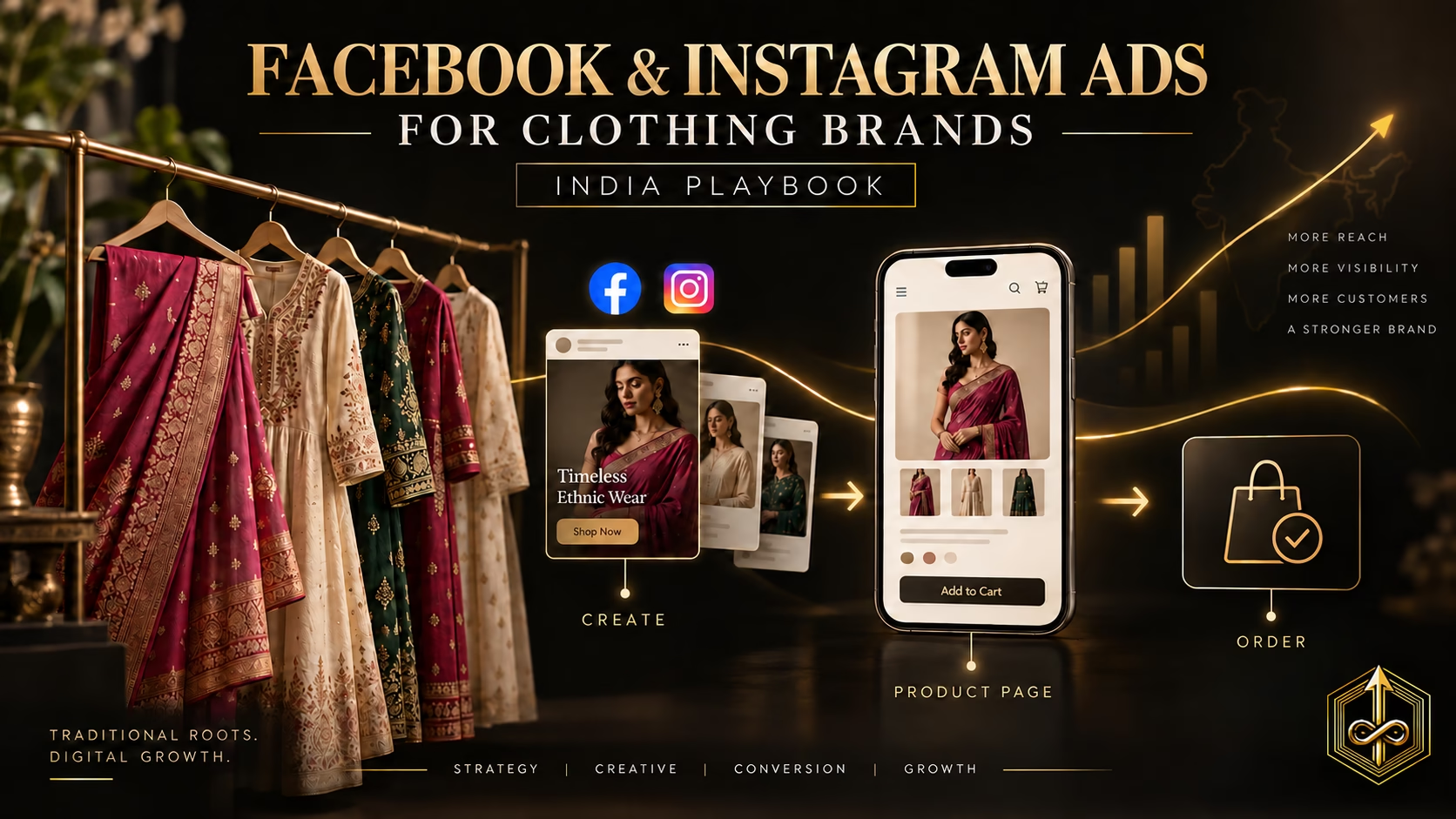
Advertising can distribute a premium message, but it cannot create premium positioning alone. Product truth, visuals, website, offer, proof, service and fulfilment must support the promise in the advertisement. Otherwise paid reach merely increases the number of people who see the inconsistency.
How many images should a product page contain?
There is no universal number. The gallery should include enough distinct evidence to answer visual objections without repetition. For many clothing and jewellery products, a sequence containing a clean hero, detail, alternate angle, realistic scale, on-model context, construction, styling and packaging is more helpful than numerous similar photographs.
Is WhatsApp enough to sell online?
WhatsApp is powerful for assisted conversion and relationships, but relying on it for every explanation creates manual work and inconsistent service. A strong website or catalogue should answer standard questions. WhatsApp should help customers who need personal guidance, not compensate for missing product information.
When should a business scale advertising?
Scale after validating customer response, page conversion, product economics, fulfilment and follow-up. Increasing spend before these elements are stable can increase losses and service pressure. Decisions should use contribution and return-adjusted economics rather than revenue alone.
How quickly should SEO backlinks improve rankings?
There is no fixed timeline. Search performance depends on relevance, crawlability, site quality, competition, link context and the strength of the destination page. A new backlink may be discovered quickly but influence rankings gradually. Links should be evaluated as part of a wider authority system, not as isolated shortcuts.
Are directory links useful?
Accurate profiles on reputable business, professional and industry platforms help validate an organisation and can produce referral discovery. Large volumes of irrelevant or automated directory submissions provide little strategic value and may create inconsistent information. Prioritise relevance, legitimacy and complete business details.
Methodology and limitations
This edition is an evidence review and practical benchmarking framework. Market figures were drawn from publicly available IBEF sector pages and summaries available at the time of preparation. IBEF aggregates information from government and industry sources; readers should consult the linked source pages for context and later updates. Operational analysis reflects Meri Digital Pehchan’s 4-Step Online Sales Engine and its work with traditional and product-based business owners.
The report does not assume that every category behaves identically. Precious jewellery, fashion jewellery, sarees, occasion wear, everyday kurtis and premium designer products differ in frequency, order value, customer risk, fulfilment and returns. The framework must be applied with category-specific data. Market projections are forward-looking estimates and may change.
No benchmark score guarantees sales. A score helps a business decide where to investigate, test and improve. External publishers citing this report should distinguish market data attributed to IBEF from the Online Brand Readiness Score developed by Meri Digital Pehchan.
Sources and suggested citation
- India Brand Equity Foundation: E-commerce Industry in India.
- India Brand Equity Foundation: Retail Industry in India.
- India Brand Equity Foundation: Gems and Jewellery Industry in India.
- IBEF summary of India’s e-retail outlook and online-shopper base.
Suggested citation: Meri Digital Pehchan. “India Clothing & Jewellery Ecommerce Growth Report 2026: Market Signals, Buyer Behaviour and Online Brand Readiness.” September 2026.
About Meri Digital Pehchan
Meri Digital Pehchan is a specialised brand-building and scaling platform for existing clothing and jewellery businesses. It helps established product-business owners build premium online brands, create predictable online sales systems and scale with structure. Founder Vishal Saklani is an entrepreneur, author of Beyond the Counter, TEDx speaker and Clothing & Jewellery Brand Growth Mentor.
Brand promise: Build Your Brand. Grow Online. Scale With a System.
Definitions for journalists and business owners
Established business: a trading, retail or manufacturing business already selling products, holding stock or maintaining active supplier relationships. The report does not primarily address students, job seekers or people who have only an untested idea.
Online brand system: the coordinated set of positioning, content, product presentation, website, proof, policies, checkout, customer communication, fulfilment and measurement that enables a customer to discover, evaluate and purchase remotely.
Product presentation: the visual and written evidence explaining product truth, design, fit, scale, material, construction, styling, usage and care. Presentation is accurate when it improves understanding without materially misrepresenting the delivered item.
Qualified traffic: visitors whose category, intent, need and purchasing ability have a reasonable match with the offer. High volume is not necessarily qualified when the message attracts people outside the intended customer group.
Predictable sales system: a repeatable process in which the business can observe how audiences enter, where they hesitate, how follow-up works, what each order contributes and which improvements change results. Predictability does not mean identical daily revenue.
Premium positioning: a credible reason for a buyer to value the brand beyond the lowest available price, supported by design, curation, craftsmanship, accuracy, service, expertise, exclusivity, convenience or customer experience.
Media, educators and industry associations may reference the readiness framework with attribution to Meri Digital Pehchan and a link to the published report. Market-size figures should remain attributed to the external source identified in the relevant paragraph.