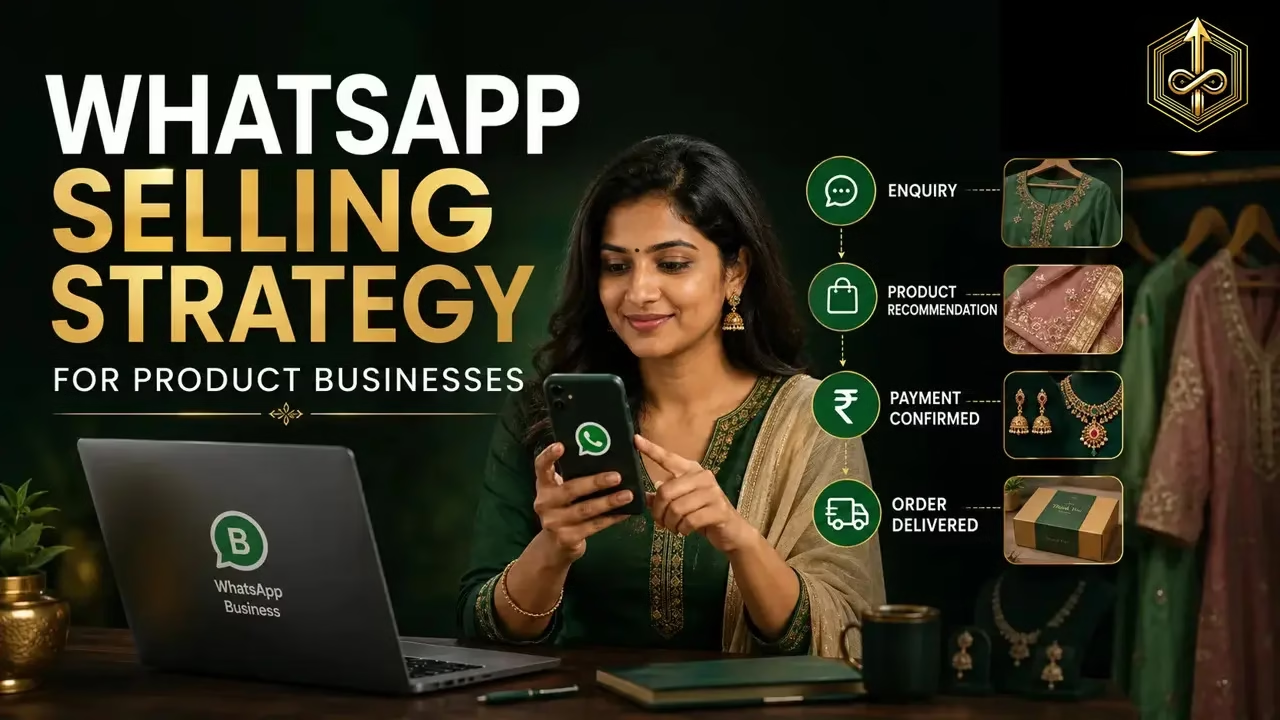
To convert WhatsApp enquiries into orders, stop treating every message as an informal chat and start managing it as a structured buying journey. The customer should receive the right product information, the right recommendation, a clear answer to her real objection and a direct path to payment—without pressure, confusion or repeated requests for information.
WhatsApp is especially important for clothing, saree, kurti and jewellery businesses because customers often need help with fit, fabric, colour, scale, styling, material, delivery and trust before purchasing. The conversation can remove uncertainty, but only when the business has a repeatable system.
Direct answer: A high-converting WhatsApp sales process has eight stages: identify the enquiry context, qualify lightly, recommend selectively, present the product completely, resolve the real objection, create a direct payment path, follow up with value and record the outcome. The process should be supported by accurate product data, clear policies, consent-based messaging and measurable lead stages.
In the Meri Digital Pehchan Online Sales Engine, WhatsApp is part of the Sales Conversion layer. It cannot repair every other layer. If the wrong customer is entering the chat, the product is poorly presented, the website is untrustworthy or the economics are weak, faster replies alone will not create a healthy business.
Know which product, post, ad or collection created the message.
Ask only what is required to recommend the right option.
Send a small number of relevant choices.
Give price, details, scale, fit, contents, delivery and policy together.
Separate fit, trust, quality, price, urgency and payment concerns.
Send the exact product or checkout link and order summary.
Add useful information or a genuine update.
Track stage, outcome, objection and delivered-order quality.
Why WhatsApp Enquiries Do Not Become Orders
An enquiry is not an order. It is a signal that the customer wants more information or is considering a decision. Some enquiries are highly qualified; others are curiosity, comparison, inspiration, low-intent browsing or accidental clicks.
Businesses often misinterpret all messages as equal and then blame the sales executive when the final order rate is low. The correct approach is to examine the entire journey.
Common reasons enquiries fail
- The ad or post attracts people outside the intended buyer segment.
- The product is not clearly differentiated.
- The price was hidden, so the message is only a request for basic information.
- The first response is slow or generic.
- The salesperson asks too many questions before giving value.
- The customer receives dozens of catalogue images instead of a recommendation.
- Price, material, fit, dimensions or contents are incomplete.
- The business does not show enough proof to reduce risk.
- The objection is assumed to be price when the real concern is trust, fit, quality or delivery.
- The payment process is unclear or manual.
- Follow-up is repetitive or pushy.
- The team does not record outcomes, so the same mistakes continue.
Separate traffic quality from sales quality
A sales process cannot convert every person who messages. First assess whether the enquiry source reaches the correct buyer. A campaign promising a low price may generate many messages from bargain-seeking people even when the product is positioned as premium. A viral video may attract admiration from viewers who are not located in the serviceable market or do not need the product.
Measure the journey in stages rather than looking only at total messages:
- Messages received
- Messages with identifiable product interest
- Qualified enquiries
- Recommendations sent
- Checkout or payment links sent
- Orders placed
- Orders confirmed
- Orders delivered
- Orders retained after the return period
This prevents the team from celebrating enquiry volume while the business loses money through low intent, cancellations, return-to-origin or returns.
What Must Be Ready Before the Team Starts Selling
A salesperson cannot provide accurate answers when product data is scattered across supplier messages, handwritten notes and personal memory. Build the operating foundation first.
Product master
Every sellable SKU should have a central record containing:
- Product name and SKU
- Current price and approved offer
- Available stock by size, colour or variant
- Material, fabric, plating or finish information that can be supported
- Dimensions, measurements or weight
- What is included
- Care instructions
- Product limitations or natural variation
- Dispatch time
- Delivery guidance
- Exchange, return and damage-reporting rules
- Direct product or checkout link
- Approved images and video
- Common objections and accurate answers
Approved product media
The team should not send random images from personal phones. Create approved media folders or product links that contain:
- Clean hero image
- Front, back and alternate views
- Fabric or craftsmanship close-ups
- On-model scale or fit reference
- Measurement or size guide
- What-is-included image
- Movement or demonstration video
- Packaging image where relevant
Clothing sellers can use the complete visual framework in the premium kurti product-presentation guide. Jewellery businesses should review the jewellery-page trust audit.
Clear commercial boundaries
Document what salespeople may and may not change:
- Maximum approved discount
- Prepaid or COD conditions
- Shipping charges
- Reservation period
- Customisation rules
- Exchange and return exceptions
- Damage or wrong-item escalation
- Authority required for special approvals
Without boundaries, different team members make different promises. The customer may then receive an experience the business cannot fulfil.
Stage 1: Identify the Enquiry Context
The first response should show that the business understands what created the message. “How may I help you?” is often too generic when the customer has already clicked a specific product, ad or post.
Capture the source
Where possible, record:
- Product or collection
- Website page
- Instagram post or reel
- Advertisement or campaign
- Creator or referral source
- Existing-customer conversation
- Abandoned cart or checkout
Use source-specific links, message text or campaign parameters where available. The objective is not technical complexity; it is to avoid making the customer repeat information the business already has.
Acknowledge with relevance
Hello, thank you for checking our navy embroidered kurta set. I can help you with size, fabric, delivery and availability. Are you looking at it for a particular occasion or date?
This response identifies the product, explains what help is available and asks one useful question.
Do not overwhelm the opening
A long automated paragraph containing every policy can feel impersonal. Use the first message to acknowledge context, set the tone and move to the next decision.
Stage 2: Qualify Without Interrogating
Qualification should improve the recommendation. It should not make the customer complete an application before receiving basic information.
Ask only questions that change the recommendation
Useful clothing questions may include:
- Which occasion or use is this for?
- Which size or body/garment measurement should we consider?
- Do you prefer a fitted or relaxed look?
- Is there a delivery deadline?
- What colour or product category are you considering?
Useful jewellery questions may include:
- Which outfit, neckline or occasion are you styling?
- Do you prefer lightweight or statement pieces?
- Which colour or finish are you matching?
- Is it for personal use or gifting?
- Is there a delivery deadline?
Give basic information before asking sensitive questions
If the customer asks only for price, answer it with essential context. Do not require budget, city, phone number and occasion before sharing publicly available product information.
Use progressive qualification
Ask one or two questions, provide a useful recommendation and then refine. For example:
This set is ₹3,250 and includes the kurta, bottom and dupatta. The fabric and measurements are available here. To guide the size correctly, would you prefer a regular or slightly relaxed fit?
Recognise when not to qualify further
If the customer has selected a product, checked size and is asking for the payment link, do not restart discovery. Remove friction and complete the purchase.
Stage 3: Recommend a Small, Relevant Set
Many salespeople respond to uncertainty by sending more products. Too many choices can increase confusion and make the business look like an uncurated catalogue.
Use a three-option recommendation structure
- Best match: Closest to the stated need.
- Alternative: Different colour, scale or price while serving the same purpose.
- Upgrade or complement: A stronger option only when it genuinely adds value.
Explain why each option is relevant. “Sharing more designs” is less useful than:
Based on your preference for a lightweight festive look, these are the two closest options. The first has a softer drape and smaller embroidery; the second is more structured and photographs as a stronger statement. I have included the model images, measurements and delivery information for both.
Do not recommend unavailable products
Inventory must be current. Recommending an unavailable size or colour wastes the conversation and weakens trust. When stock is genuinely limited, state the exact availability without creating false urgency.
Use previous behaviour carefully
For an existing customer, previous size, colour and category preferences can improve recommendations. Confirm that the information is still relevant rather than assuming every future purchase will be identical.
Stage 4: Present the Product Completely
A customer should not need to ask five separate questions to understand one product. Create a compact product information packet or direct her to a complete product page.
The minimum product packet
- Product name
- Price and current offer
- Availability
- What is included
- Material or fabric information
- Dimensions, weight or size
- Fit or on-model scale
- Care guidance
- Dispatch and delivery expectation
- Exchange, return or damage-reporting condition
- Direct checkout link
Use the website as the source of truth
Where possible, send the exact product-page link rather than repeatedly transferring media files. The page should contain the latest stock, size, price, policies and checkout. WhatsApp then provides assistance rather than replacing the entire ecommerce system.
When a product page is not ready
Use a consistent message template with approved images and information. Do not improvise important facts. The business should treat repeated manual questions as evidence that the product page needs improvement.
Example: complete clothing presentation
The set is ₹3,250 and includes the embroidered kurta, straight bottom and printed dupatta. The kurta is a regular fit; the model is 5’6″ and wears size M. I’m sharing the garment measurements, fabric close-up and movement video. Dispatch is expected within the stated product-page timeline, and the size-exchange terms are visible before checkout. Here is the exact product link: [link].
Example: complete jewellery presentation
The earring pair is ₹1,850. Total length is 7.2 cm, the closure is a push-back post and the pair weight is listed on the product page. I’m sharing a macro image, back view and on-model scale so the size is clear. Care and damage-reporting instructions are included here: [link].
Stage 5: Diagnose and Handle the Real Objection
An objection is not always a rejection. It may be a request for missing evidence. Do not respond to every hesitation with a discount.
Use the clarify–answer–confirm method
- Clarify: Understand what the customer is uncertain about.
- Answer: Give the most relevant evidence or option.
- Confirm: Check whether that information resolves the concern.
Price objection
First distinguish affordability from value uncertainty.
I understand. Is the concern mainly that this is above the budget you planned, or would it help to compare the fabric, set contents and finishing with the other option?
If the budget is fixed, recommend a suitable lower-priced product rather than forcing the original. If value is unclear, provide specific evidence. Do not make unsupported quality comparisons or pressure the customer.
Fit objection
Use product-specific measurements, model data and a comparison with an existing garment. Avoid guaranteeing fit for every body without adequate information.
The garment bust in size L is [measurement]. For a reliable comparison, measure a similar kurti that fits you comfortably from underarm to underarm and compare it with our measurement guide. The style is designed as a regular fit, and the fabric has [verified stretch information].
Colour objection
Share images from the controlled product shoot, a short video and a clear variation note. Do not promise that every screen will display colour identically.
Quality objection
Use close-ups, construction details, verified material information, quality-control process and genuine customer feedback. “Best quality” is not evidence.
Trust objection
Provide the official website, business identity, policy links, secure checkout, order confirmation process, genuine reviews and customer-support channel. Never invent proof, order counts or testimonials.
Delivery objection
Check the actual dispatch and service expectation. Do not promise an occasion date without operational confirmation. If the deadline is not realistically achievable, say so and recommend a suitable alternative.
COD or payment objection
Explain available payment methods and any genuine eligibility rules. Do not create misleading charges or urgency. Use a secure payment or checkout path and provide order confirmation.
Stage 6: Create a Direct Payment and Order Path
Once the customer is ready, the next step should be obvious. Do not make her repeat product, size, address and price information across several messages when a structured checkout is available.
Send an order summary
Before payment, confirm:
- Product and SKU
- Size, colour or variant
- Quantity
- Price and approved offer
- Shipping or payment amount
- Delivery expectation
- Applicable exchange, return or damage conditions
- Checkout or payment link
Use secure, attributable links
Prefer the exact product, cart or checkout link. The business should be able to connect the enquiry with the completed order where possible. Avoid asking customers to transfer money to unclear accounts without an order record.
Do not pressure after sending the link
Give the customer reasonable time to complete payment. A useful immediate message is:
I’ve shared the checkout link with the selected size and product details. Please review the delivery and exchange information before payment. Message me here if the payment page or variant selection creates any difficulty.
Handle failed or incomplete payment
First determine whether the issue is technical, a payment failure, variant availability, a changed decision or an objection. Do not send repeated payment reminders without context.
Stage 7: Follow Up With Value
Follow-up should help the customer decide. “Hi,” “Interested?” and “Any update?” add no value and can feel like pressure.
Principles of useful follow-up
- Refer to the exact product or need.
- Add information not already provided.
- Use genuine availability or deadline information.
- Make it easy to say no or pause.
- Stop when the customer declines or asks not to be contacted.
- Do not manufacture scarcity.
Examples of value-based follow-up
I’m sharing the movement video because you asked whether the fabric is stiff. It has a softer fall than the product photograph may suggest. The measurements and size-exchange information are in the same link.
You were comparing the two earring sizes. This on-model image shows both at the same scale, which should make the difference clearer. The smaller option remains available in the finish you selected.
I noticed the checkout did not complete. There is no need to reorder from the beginning. If the issue was the payment page, I can help you reopen the same product and variant. If you decided not to continue, I will close the enquiry.
Create a follow-up policy
The correct timing depends on the buying context, urgency, customer permission and product. Instead of a universal number of messages, define when follow-up is justified and what new value each message must contain.
Stage 8: Record Lead Stage and Outcome
A conversation that exists only inside one salesperson’s inbox cannot improve the business. Use simple lead stages and reason codes.
Recommended lead stages
- New enquiry
- Context identified
- Qualified
- Recommendation sent
- Objection or decision pending
- Checkout link sent
- Payment pending
- Order placed
- Order confirmed
- Order delivered
- Repeat customer
- Closed—no purchase
- Do not contact
Reason codes for no purchase
- Wrong product or style
- Size unavailable
- Budget mismatch
- Delivery deadline
- Trust concern unresolved
- Product information incomplete
- Payment issue
- COD unavailable or ineligible
- Customer delayed decision
- No response after useful follow-up
- Duplicate or accidental enquiry
- Outside serviceable area
- Chose another product or seller
Use these reasons to improve products, pages, campaigns and operations. Do not use them only to judge individual employees.
Practical WhatsApp Message Examples
Scripts should create consistency, not robotic conversation. Adapt the wording to the customer’s question and the brand voice.
First response to a specific product enquiry
Hello, thank you for checking the
. It is currently available in [relevant variants]. I can help with [size/scale/material], delivery and the exact checkout link. Are you purchasing it for a particular occasion or date?

Price response
The price is ₹[amount]. It includes [contents]. I’m also sharing the [fabric/material], measurements and on-model reference so you can judge the product properly before deciding.
Size recommendation
For the most reliable selection, compare the garment measurement with a similar kurti that fits you comfortably. Size [X] measures [measurement] at the bust and is designed as a [fit] cut. The model is [height/measurements] and wears [size].
Alternative recommendation
The first option is closest to the colour and occasion you described. The second is a little lighter and more relaxed in fit. I’m sharing only these two because they match your requirement better than the rest of the collection.
Trust response
You can review the complete product information, genuine customer feedback, shipping and exchange terms on our official website here: [link]. The order is confirmed after checkout and tracking is shared through the stated process.
Payment-link handoff
Your selected item is , [variant], quantity [X], at [amount]. Here is the secure checkout link: [link]. Please review the delivery and policy details before payment, and message me if the page creates any issue.
Follow-up after an unanswered recommendation
I’m following up on the you viewed. I’m adding the [movement/scale/detail] video because it answers the question you raised about [concern]. I will close the enquiry if you are no longer considering it—no problem.
Polite close
Thank you for considering the collection. I’ll close this enquiry for now so you do not receive unnecessary follow-ups. You can message us again anytime with the product link if you need help.
WhatsApp Selling for Clothing, Saree and Kurti Businesses
Clothing conversations should prioritise fit, fabric, contents, occasion and delivery.
Clothing information checklist
- Garment measurements
- Body-size guidance where applicable
- Fit description
- Fabric and lining
- Stretch and transparency
- Kurti, bottom and dupatta dimensions
- Model measurements and size worn
- What is included
- Care
- Exchange or return conditions
Saree information checklist
- Fabric or weave information that can be verified
- Total length and width
- Blouse-piece inclusion and details
- Border and pallu
- Transparency, weight or drape guidance where relevant
- Close-up of weave, print or work
- Full drape and movement video
- Care
- Natural variation
- Delivery and policy
A “price please” comment does not indicate full buying intent. Read why saree enquiries often stop before an order.
Do not guess size from a photograph
Ask for relevant measurements or help the customer compare a garment. Avoid guarantees based only on height, weight or appearance. Fit depends on body shape, pattern, fabric and preference.
WhatsApp Selling for Jewellery Businesses
Jewellery conversations should prioritise scale, dimensions, weight, material or finish, closure, outfit pairing, care and trust.
Jewellery information checklist
- Product type and set contents
- Dimensions
- Weight
- Closure or fastening
- Material, plating or finish information that can be supported
- Stone or decorative details
- On-model scale
- Front, side, back and macro images
- Care and storage
- Packaging
- Damage-reporting and policy information
Avoid unsupported claims
Do not use “waterproof,” “anti-tarnish,” “hypoallergenic,” “skin safe” or “lifetime finish” as generic selling phrases. Use only claims supported by reliable product evidence and explain care and limitations accurately.
For the complete online jewellery system, read How to Sell Artificial Jewellery Online in India.
How to Use Catalogues, Links and Saved Information
WhatsApp Business products and features can change by account, device, market and product version. Design the process around the capabilities actually available to your business and verify current options through the official WhatsApp Business resource.
Use a catalogue for orientation, not as a substitute for product truth
A catalogue can help customers browse, but each item still needs accurate price, availability, media and details. Keep catalogue and website information consistent.
Use direct links
Send the exact product or collection link rather than the homepage. A direct link preserves context and reduces the number of steps to payment.
Use saved responses carefully
Saved answers are useful for recurring questions such as size measurement, care, shipping and policy. Personalise the opening and product context so the customer does not feel ignored.
Use labels or stages consistently
If the account supports labels or the team uses a CRM, define one shared stage system. Do not allow every salesperson to create private labels with different meanings.
Separate service from promotion
Order updates, customer support and promotional messages have different purposes. Keep records of customer permission and do not use a service conversation as unlimited permission for unrelated marketing.
Consent, Privacy and Responsible Messaging
Trust can be lost when a business adds every enquirer to broadcast lists or repeatedly messages people who did not request promotions.
Responsible principles
- Explain why contact information is collected.
- Use customer information only for legitimate stated purposes.
- Obtain appropriate permission before promotional messaging.
- Provide a clear way to stop messages.
- Respect a decline or do-not-contact request promptly.
- Limit internal access to customer information.
- Do not send sensitive payment information insecurely.
- Use official business tools and current policies where required.
- Retain only the information the business needs and is permitted to keep.
Messaging, privacy and ecommerce obligations depend on the business, location, tools and current law. Verify your implementation through official platform documentation and qualified legal or compliance advice rather than relying on a generic article.
Do not manufacture urgency
“Only one left” should be used only when the inventory information is accurate. False scarcity may pressure a purchase but damages trust and creates compliance risk.
Team SOP, Quality Control and Manager Review
A scalable sales process needs documented standards and coaching.
Minimum SOP
- Open and acknowledge the enquiry within the team’s defined service standard.
- Identify source and product.
- Check current stock and approved price.
- Ask only necessary qualification questions.
- Send a relevant recommendation and complete information.
- Record the lead stage.
- Handle the objection using approved facts.
- Send the checkout link and order summary.
- Follow up only according to policy.
- Record the final outcome and reason.
Quality-review checklist
A manager can review a sample of conversations using these questions:
- Did the response recognise the customer’s context?
- Was the information accurate?
- Were unnecessary questions avoided?
- Was the recommendation relevant and limited?
- Were price, contents, size or scale and policy complete?
- Was the real objection identified?
- Was a direct checkout path provided?
- Was follow-up respectful and useful?
- Was the stage and outcome recorded correctly?
- Were unsupported claims or false urgency avoided?
Coach from patterns, not isolated mistakes
If several team members give incomplete size information, the product master or training may be weak. If customers repeatedly question authenticity, the website and presentation may need repair. Use conversation data to improve the system, not only to monitor employees.
Metrics That Matter
Volume metrics
- Total enquiries
- Enquiries by source
- Enquiries by product or collection
- New versus repeat customers
Quality metrics
- Qualified enquiry rate
- Recommendation-to-checkout-link rate
- Checkout-link-to-order rate
- Enquiry-to-order rate
- Enquiry-to-delivered-order rate
- Average order value from assisted sales
- Contribution per delivered assisted order
- Cancellation, return and RTO rate
- Repeat-purchase rate
Service metrics
- Time to useful first response
- Time to resolution
- Number of handoffs
- Product-information accuracy
- Customer complaint and escalation reason
Learning metrics
- Top objections by product
- Top missing information
- Most requested sizes, colours and categories
- Reasons for no purchase
- Reasons for return or dissatisfaction
Do not reward only message volume or speed. A rushed response that gives wrong information may create a placed order and a later return. Measure delivered customer and commercial outcomes.
Diagnosing Conversion Problems
| Observed pattern | Likely causes | Next investigation |
|---|---|---|
| Many messages, few qualified enquiries | Wrong audience, hidden price or curiosity-led creative | Traffic source, ad promise, price transparency and buyer relevance |
| Qualified buyers stop after product details | Weak value, proof, fit, scale or trust | Product packet, comparison, reviews, policies and page quality |
| Links sent, few orders | Checkout friction, surprise cost or unresolved objection | Mobile checkout, shipping, payment errors and conversation close |
| Orders placed, many cancellations | Low commitment, wrong expectation, weak verification or delivery issue | Payment method, confirmation, delivery expectation and source quality |
| Delivered orders, many returns | Product mismatch, inaccurate presentation, fit or QC | Return reason by SKU, page accuracy and product quality |
| One salesperson converts much better | Better diagnosis, product knowledge or follow-up | Review conversation patterns and convert them into training |
Use the full ecommerce framework in How to Sell Products Online in India to diagnose whether the constraint sits before or after WhatsApp.
14-Day Implementation Plan
Days 1–2: Audit
- Review recent enquiries across products and sources.
- List repeated questions, objections and no-purchase reasons.
- Identify inaccurate or missing product information.
- Separate traffic-quality problems from sales-process problems.
Days 3–4: Product master
- Create one source of truth for priority SKUs.
- Verify prices, stock, measurements, materials, contents and policies.
- Build approved product media packets.
- Add exact product and checkout links.
Days 5–6: Lead stages and scripts
- Define lead stages and no-purchase reason codes.
- Write first-response, qualification, recommendation, objection, checkout and close templates.
- Define discount and approval boundaries.
- Create do-not-contact handling.
Days 7–8: Team training
- Demonstrate the eight-stage flow.
- Practise clothing and jewellery scenarios.
- Train the team to distinguish price, trust, fit, quality and urgency objections.
- Review unsupported claims and false scarcity.
Days 9–10: Technical path
- Update product pages.
- Test direct links and checkout on mobile.
- Confirm order attribution and status handoff.
- Set up approved catalogue, saved information or CRM fields as appropriate.
Days 11–12: Controlled use
- Use the process on a defined set of enquiries.
- Review a sample of conversations daily.
- Correct product-data and process gaps.
- Collect customer questions the system did not anticipate.
Days 13–14: Measurement and improvement
- Compare qualified enquiries, links sent, orders and delivered outcomes.
- Review no-purchase reasons by product and source.
- Identify training, page, offer or traffic changes.
- Document the next iteration.
The plan builds a functioning process; it does not guarantee a particular sales volume. Conversion depends on the buyer, product, price, presentation, website, traffic, competition and operations.
WhatsApp Sales System Scorecard
Score each statement from 0 to 2:
- 0: Not in place
- 1: Partly or inconsistently in place
- 2: Documented and consistently executed
| Area | Diagnostic statement | Score |
|---|---|---|
| Context | The team knows the product and source that created the enquiry. | 0 / 1 / 2 |
| Product data | Prices, stock, specifications, media, policies and links are current. | 0 / 1 / 2 |
| Qualification | Questions are limited to information that improves the recommendation. | 0 / 1 / 2 |
| Recommendation | The customer receives a small set of relevant options and the reason for each. | 0 / 1 / 2 |
| Objections | The team distinguishes fit, quality, trust, price, urgency and payment concerns. | 0 / 1 / 2 |
| Checkout | A direct secure payment path and order summary are provided. | 0 / 1 / 2 |
| Follow-up | Follow-up adds value, respects permission and stops appropriately. | 0 / 1 / 2 |
| Measurement | Lead stages, reasons and delivered outcomes are recorded. | 0 / 1 / 2 |
Common Mistakes
Answering every enquiry with the full catalogue
This transfers the selection work back to the customer. Recommend a small relevant set.
Hiding basic information
Forcing customers to ask for price, size or material can inflate message volume without improving purchase quality.
Using only copy-paste scripts
Templates improve consistency, but the response must reflect the actual product and question.
Assuming every objection is price
The customer may need proof of fit, quality, scale, trust or delivery. Diagnose before discounting.
Making promises outside policy
Unapproved delivery, exchange or product claims create future disputes. Use a central source of truth.
Sending payment details without an order record
Create a secure, attributable checkout and confirmation process.
Following up without value
Repeated “interested?” messages create pressure and do not resolve the decision.
Adding every enquirer to promotions
A service enquiry is not unlimited promotional consent. Use responsible permission-based messaging.
Measuring only placed orders
Track delivery, returns, RTO, contribution and repeat purchase to understand true quality.
Frequently Asked Questions
How quickly should a business reply on WhatsApp?
Set a service standard your team can meet consistently and prioritise a useful response rather than an empty automated acknowledgement. Response expectations depend on business hours, product complexity and staffing. Clearly communicate hours and next-response expectations.
What should the first WhatsApp reply contain?
Acknowledge the exact product or context, answer the basic question when possible, explain what help is available and ask one useful qualifying question. Avoid a long generic paragraph.
Should I share the price immediately?
In most product-selling situations, transparent pricing helps serious buyers self-qualify. Share the price with what is included and the information needed to understand value. Custom products may require a starting price and a clear explanation of what changes it.
How many products should I recommend?
Usually a small set is easier to evaluate than the whole catalogue. Choose the best match and one or two relevant alternatives. Explain why each fits the customer’s need.
How many times should I follow up?
There is no universal number. Follow up only when you have useful new information, genuine availability context or a checkout issue to resolve. Respect a decline, no-contact request and customer permission. Stop repetitive pressure.
What should I say when a customer says the product is expensive?
Clarify whether the concern is a fixed budget or uncertainty about value. If the budget is fixed, recommend a suitable alternative. If value is unclear, provide specific evidence about material, contents, measurements, finishing, proof and service—without exaggeration.
How do I convert a “price please” message?
Answer the price, state what is included, share the most important product proof and ask one relevant question about occasion, size or preference. Do not assume the message represents strong buying intent.
Should I send images or a website link?
Use the exact product-page link when it is complete and current. Add one or two relevant images or videos in the chat when they answer a specific question. Avoid sending dozens of files that separate the customer from price, stock and checkout.
How can a jewellery business build trust on WhatsApp?
Share original macro, back and on-model scale images, dimensions, weight, closure, supported material information, care, policy links, secure checkout and genuine customer proof. Avoid unsupported durability or skin-safety claims.
How can a clothing business recommend the correct size?
Use product-specific garment measurements, a measurement guide, fit description, model data and comparison with a garment the customer already owns. Avoid guaranteeing fit based only on height or weight.
Is COD necessary for WhatsApp sales?
COD is a commercial decision. Evaluate customer demand, verification, serviceability, order value, RTO cost and product risk. Use clear and fair eligibility rules rather than enabling or denying it inconsistently.
How do I manage many WhatsApp enquiries?
Centralise product data, define lead stages, use approved templates, assign ownership, connect direct checkout links and review performance. The correct tool may range from the WhatsApp Business app to an official business platform or CRM setup, depending on volume and current availability.
Can I add all customers to a broadcast list?
Use appropriate permission and follow current platform and legal requirements. A prior order or enquiry does not automatically justify unlimited promotional messaging. Make the purpose clear and provide a way to stop.
What is a good WhatsApp enquiry-to-order rate?
There is no universal benchmark because enquiry intent, product, price, channel, geography, season and qualification differ. Establish your own baseline by source and product, then improve qualified and delivered-order conversion without weakening contribution or customer experience.
How do I know whether the salesperson or the traffic is the problem?
Compare stages. If few messages are qualified, inspect targeting, creative and price transparency. If qualified customers receive recommendations but no checkout link, inspect the sales process. If links are sent but payment fails, inspect objections and checkout. If orders are returned, inspect product truth and operations.
Should I automate WhatsApp replies?
Automation is useful for acknowledgement, routing, common information and status updates when implemented through appropriate tools. Keep a clear route to human help and do not automate misleading, irrelevant or excessive messages. Verify current official capabilities and policies before implementation.
Build a Sales System, Not a Collection of Chats
WhatsApp converts best when it continues a strong buying experience. The right buyer sees an accurately presented product, reaches a complete page or conversation, receives relevant help and can complete payment without confusion.
Start by fixing the weakest layer. If enquiries are low quality, improve buyer clarity and traffic. If customers ask basic questions, improve product presentation and product pages. If qualified buyers hesitate, improve objection diagnosis and trust. If payment is difficult, repair checkout. If placed orders cancel or return, improve expectations and operations.
Continue with How to Sell Clothes Online in India or How to Sell Artificial Jewellery Online in India for the complete category-specific system.
Audit your WhatsApp Sales Conversion layer
Meri Digital Pehchan helps Indian clothing, saree, kurti and jewellery businesses build online brands through Buyer Clarity, Product Presentation, Converting Website, Traffic, Sales Conversion and Retention.